
Welcome back to our spotlight series where we are kicking off with our first spotlight of 2026! This spotlight focuses on some objects made by the Jarrow Library Knit & Natter group. They have kindly allowed us to display these pieces for a time.
The Jarrow Library Knit & Natter group formed within Jarrow Focus, and its members meet weekly to craft and chat! They have practiced several traditional creative skills, including making clippy mats.
The group created ceramic hearts on display as part of Jarrow Forward. This is a neighbourhood board supported by South Tyneside Council. It is made up of representatives from Jarrow’s schools, health services, police, businesses, community organisations as well as the Council and the MP for Jarrow & Gateshead East. Its aim is to consult local people on how to improve Jarrow for the future.
The hearts celebrate Jarrow and everything the Knit & Natter group love about the town. The group also wanted to recognise people from Jarrow who have been significant in its history, heritage and industry.
We would like to thank the Knit & Natter group for allowing us to display these lovely pieces. They commemorate people and events which have shaped Jarrow and made it into the place we know today.
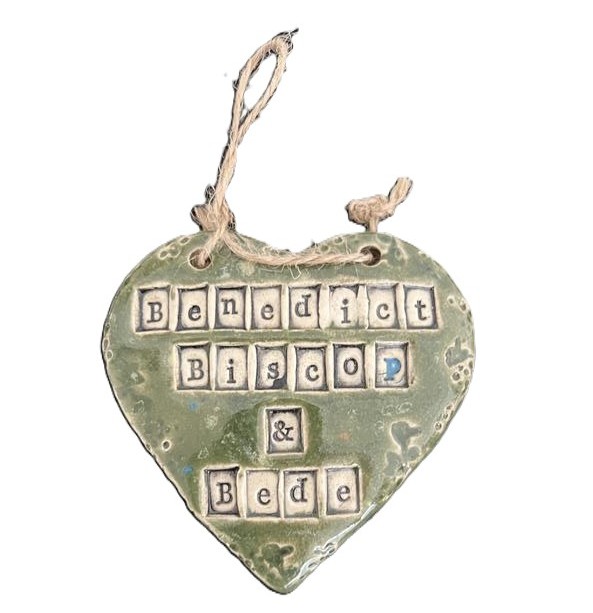
This green heart reads ‘Benedict Biscop & Bede’. Benedict Biscop was born to a noble family in Northumbria in about 628 AD. He made about 5 trips to Rome over the course of his life. During the first trip he became interested in the English Church. On his second, he took monastic vows. In around 674 AD King Ecgfrith of Northumbria granted him land to found a monastery. He therefore founded St Peter’s in Monkwearmouth. If you have seen our placement student Grace’s blog post you may remember that Benedict Biscop brought glassmakers from France to create the windows for this monastery. They produced the first stained glass made in Britain and taught local workers how to make it! Following this, Benedict Biscop founded a sister monastery to St Peter’s here in Jarrow – St Paul’s – in 681 AD.
The monasteries became a renowned centre of learning due to the extensive library acquired by Benedict Biscop and his successor Ceolfrith on trips to the continent. Benedict Biscop died in 690 AD. He was a very important part of the Anglo-Saxon history of Jarrow, creating a centre of learning known all over the world. Thanks to him, the monasteries produced incredible works like the Codex Amiatinus, the oldest complete surviving copy of the Latin Vulgate Bible. They also educated Bede, one of the most important English scholars of the age.
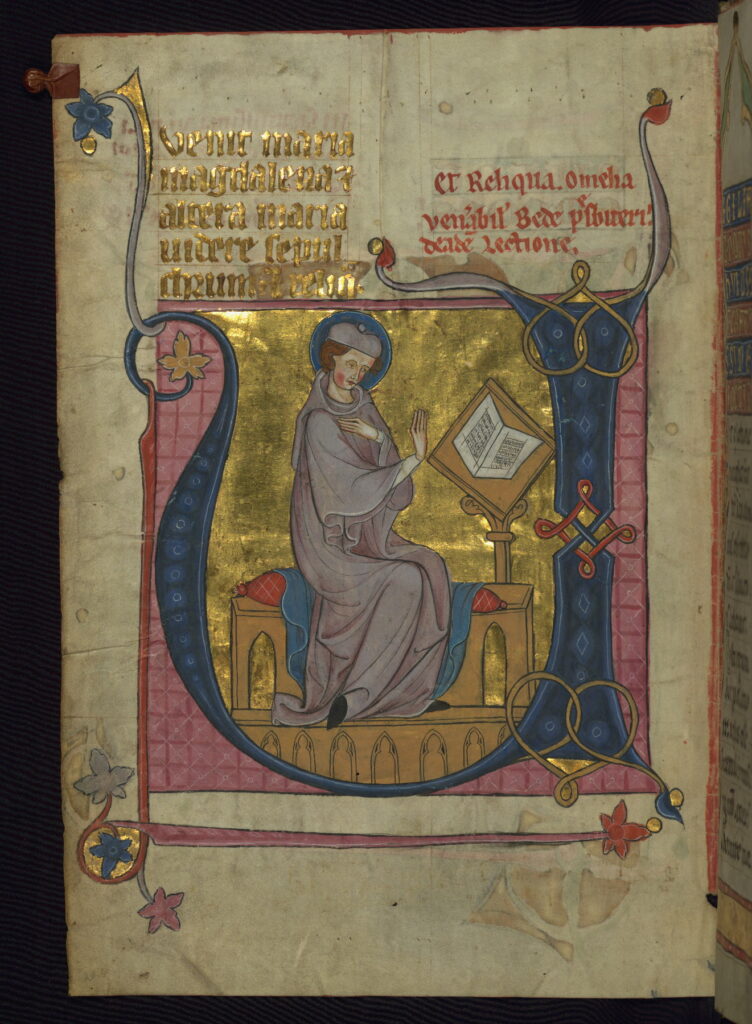
Walters Art Museum. Public Domain
Bede was one of the most important scholars in Anglo-Saxon England and spent most of his life here in Jarrow. He was most likely born to a noble family, and he was dedicated to the monastery at Monkwearmouth when he was seven years old. Bede was a pupil of Benedict Biscop’s. He later moved to the monastery of St Paul’s in Jarrow, where he spent the rest of his life.
We often call Bede the Father of English History, because his work An Ecclesiastical History of the English People is one of the most important references we have of Anglo-Saxon history. However, he produced works about theology as well as cosmology and he was also a skilled linguist and translator. He even produced the first tide tables!
He was a very influential scholar whose work is still very important to us today. Bede died in 735 AD at St Paul’s monastery in Jarrow.
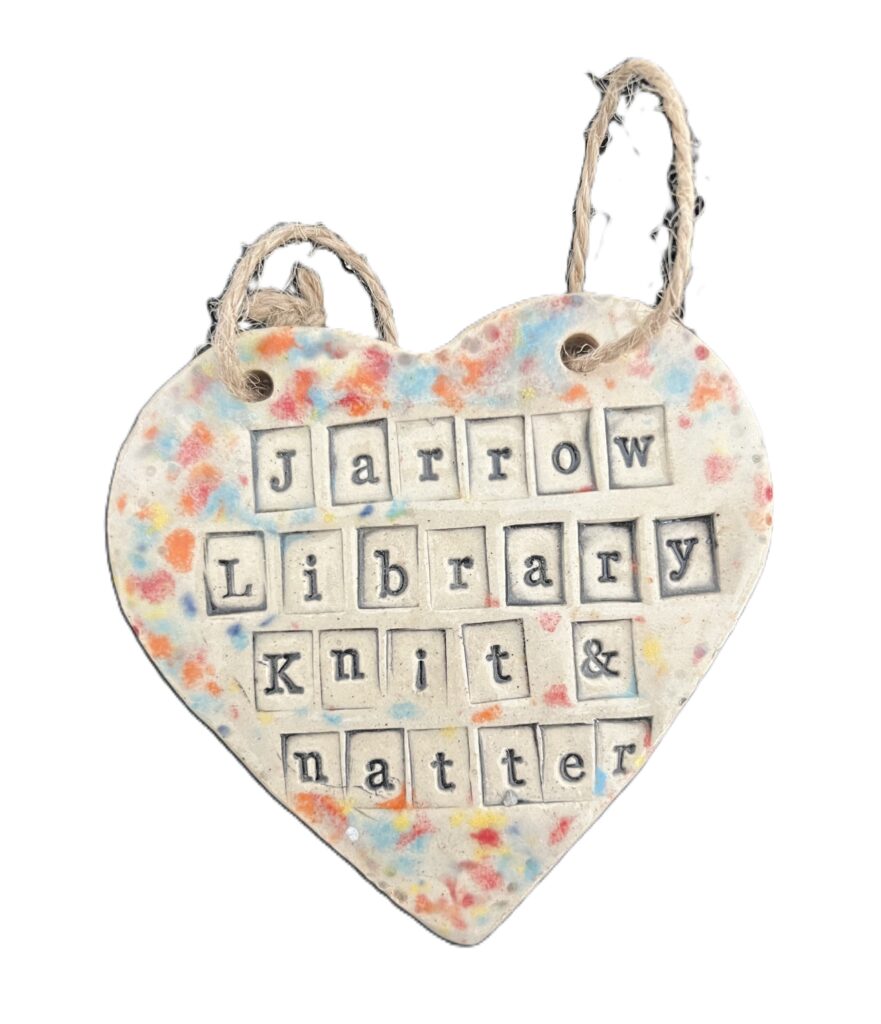
This heart reads ‘Jarrow Knit & Natter’ and commemorates the group and its foundation. Groups like this one encourage people to visit their local libraries and community spaces. They also allow people to socialise and pursue creative hobbies, which is incredibly important for wellbeing. They add a lot of value to people’s lives.
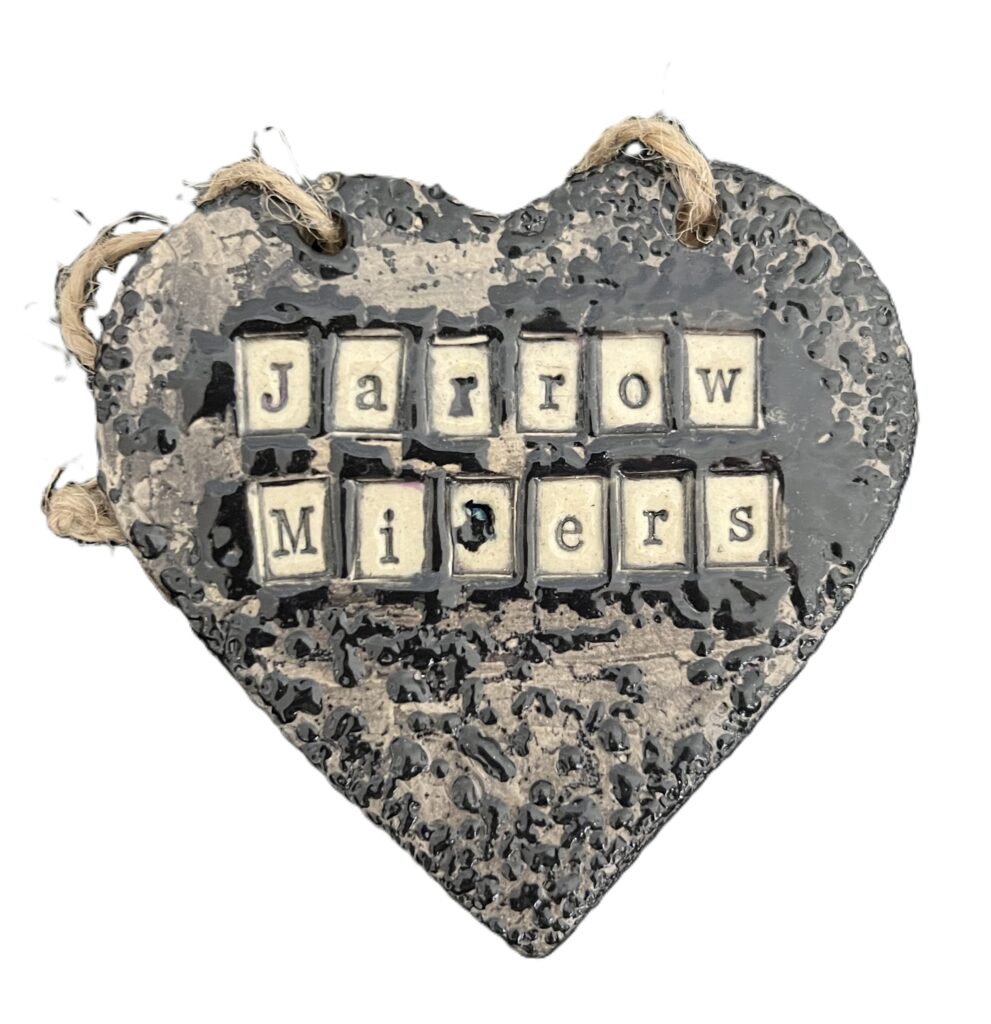
The black heart commemorates the Jarrow miners. Mining was a very important industry in this area, particularly in the 19th century. These miners worked in extremely dangerous working conditions, and there were and there were several explosions in the Jarrow colliery which resulted in significant loss of life, particularly in 1826, 1830 and 1845. The miners went on strike in 1832 and 1844 to campaign for better working conditions despite the authorities targeting them as a result.
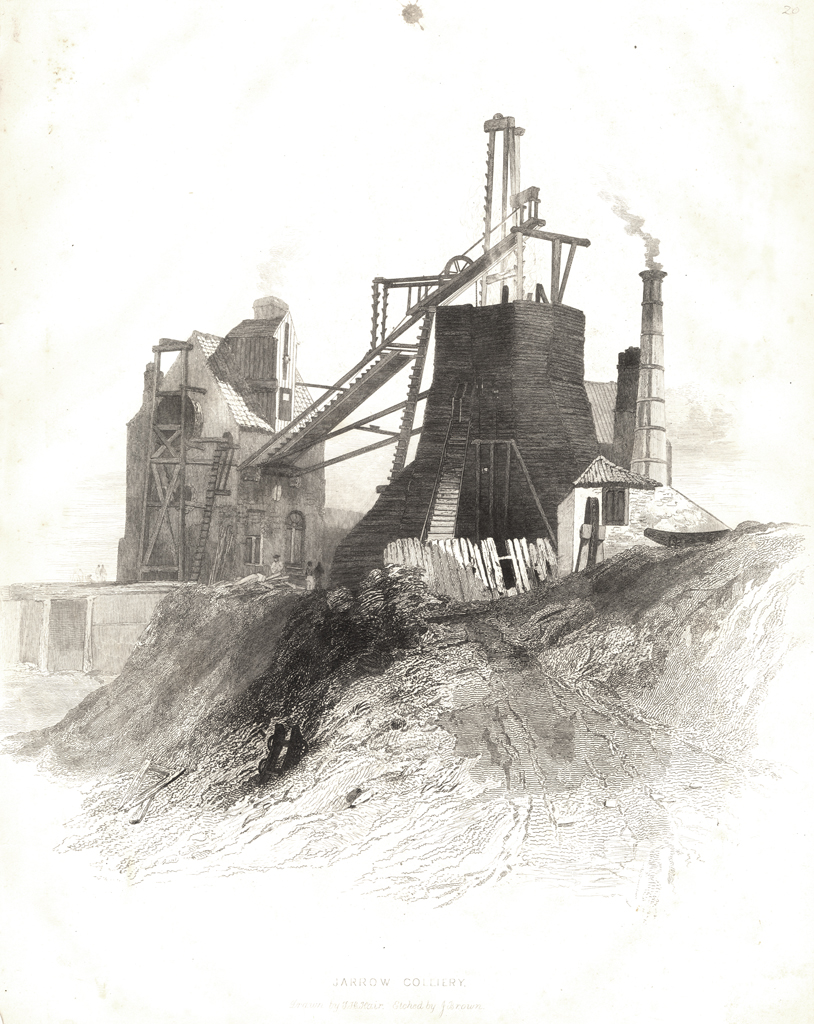
For example, the Seven Men of Jarrow were seven miners (Thomas Armstrong, John Barker, Isaac Ecclestone, David Johnson, John Smith, Batholomew Stephenson and John Stewart) who were transported to a penal colony in Australia on what many consider to be trumped-up charges due to their involvement in strikes and union work. The annual Jarrow Rebel Town Festival commemorates these men.
Another example is William Jobling, who was executed in 1832 and one of the last people in England to be hung and gibbeted. He was convicted of murdering a local magistrate and at the time was heavily involved in strikes against the bond system. This restrictive system bound miners to work for a particular mine owner for a year and a day. However, many think another miner, Ralph Armstrong, struck the fatal blow and fled. Many consider the harshness of William Jobling’s punishment and his treatment by the judicial system to be due to his involvement in these strikes. In 2012, the Mayor of South Tyneside unveiled a sandstone plaque commemorating Jobling.
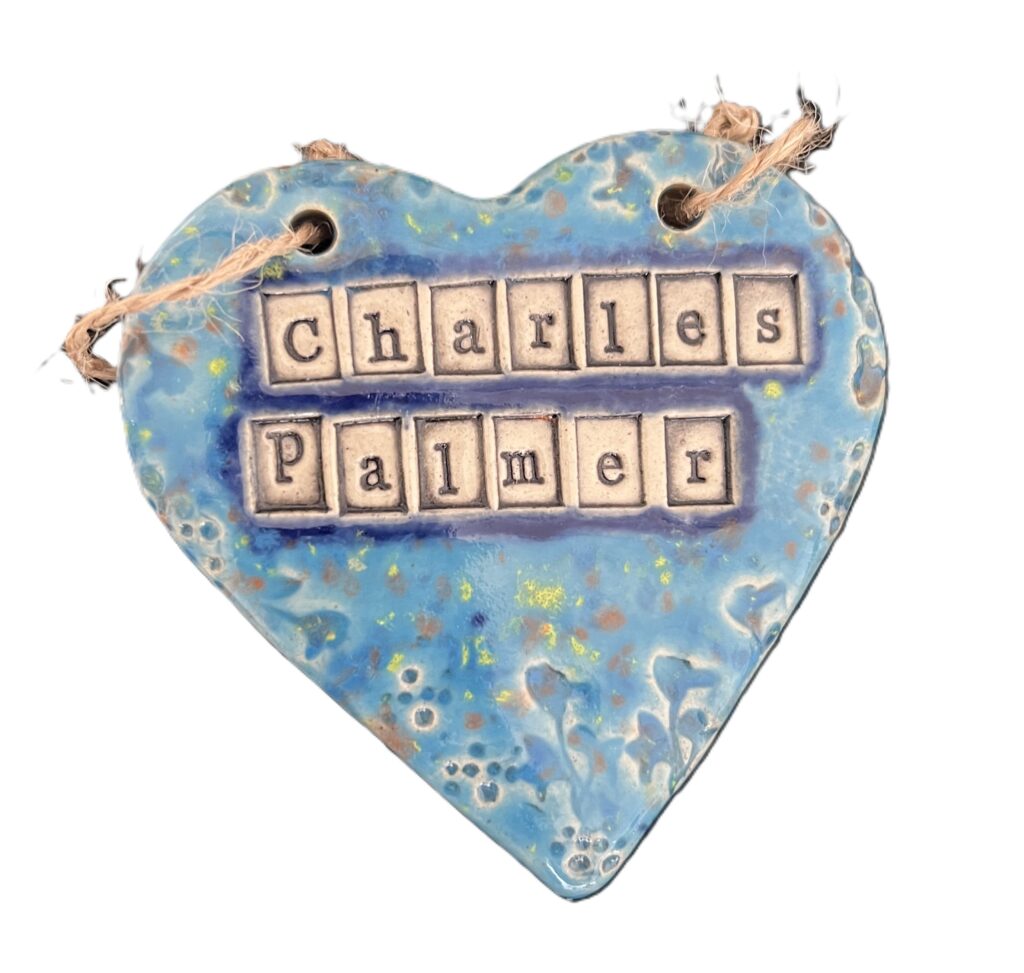
This piece celebrates Sir Charles Palmer. Palmer was the first mayor of Jarrow but also a very important figure in the town’s industrial history. He was born in South Shields and became a partner in his father’s ship owning and ship-broking business. He was also the owner of the shipbuilding company Palmers Shipbuilding and Iron Company Limited.
This company not only built ships but also manufactured its own steel and other weapons and included blast furnaces and steelworks. It built both merchant vessels and warships, including the HMS Queen Mary. This was the last battlecruiser built by the Royal Navy before the First World War.
The company also launched, created according to Palmer’s own plans, the John Bowes, the first iron screw collier. The business was a hugely important employer in Jarrow, and by 1902 employ over 10,000 people. When the company collapsed during the Great Depression in 1933, the resulting loss of jobs was a trigger for the Jarrow March in 1936, which you can read more about below.
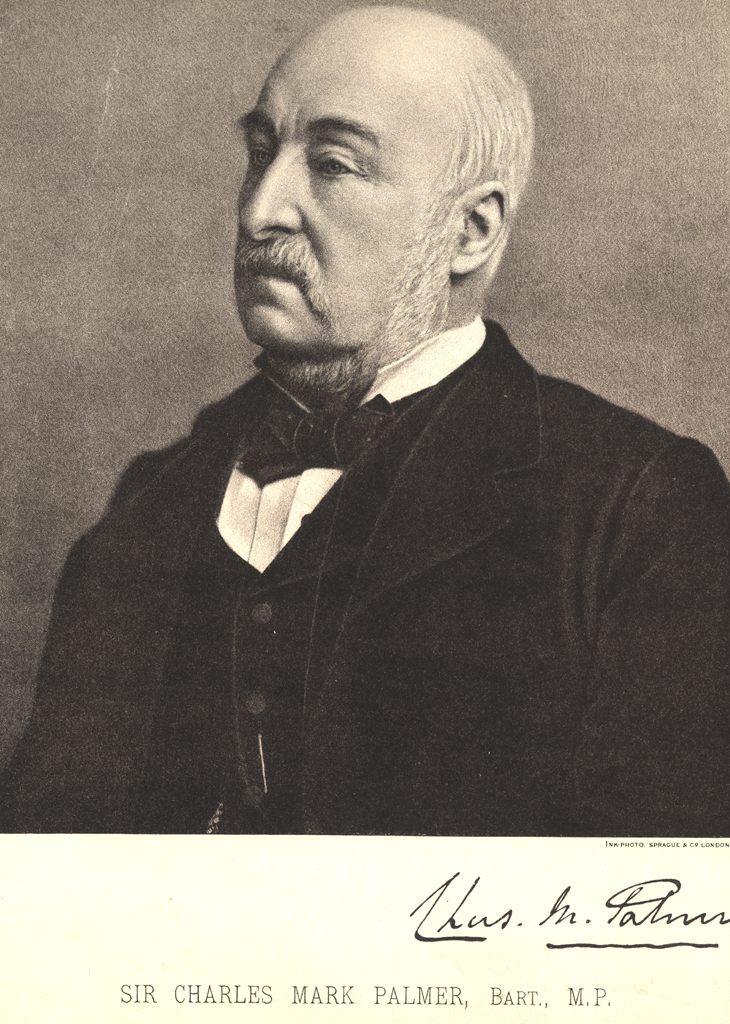
Sir Charles Palmer also had a political career; he was the first mayor of Jarrow and held the position twice. He was also MP for Jarrow from 1885 until his death in London in 1907. A statue opposite Jarrow’s town hall commemorates Palmer as an influential figure in the town’s history.

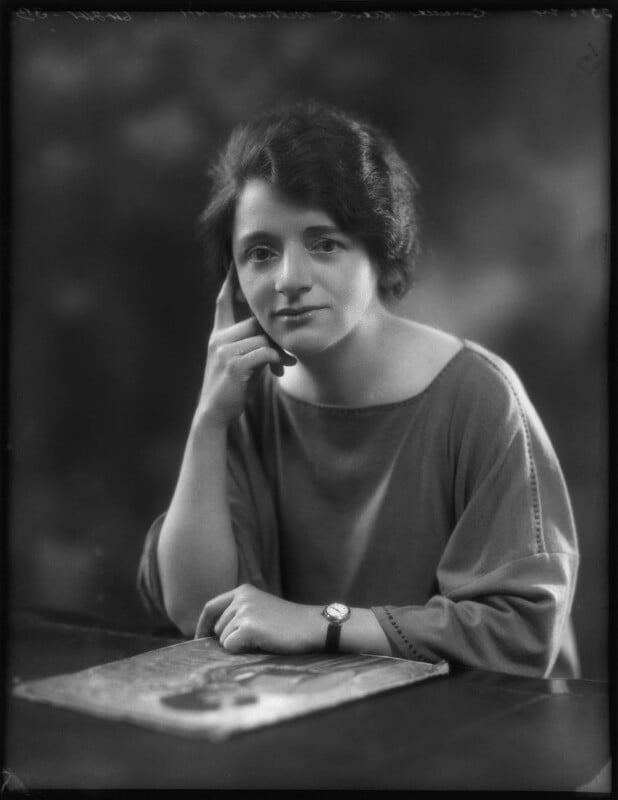
The next heart commemorates The Right Honourable Ellen Wilkinson. She was born in Manchester in 1891 and developed an interest in social justice early in life. After graduating from university, she worked for a women’s suffrage organisation and later as a trade union officer. Later she developed a career in politics.
She became MP for Jarrow in 1935 and played a key part in the Jarrow March of 1936. You can read more about the march in the following section. Wilkinson joined with the march whenever her commitments allowed and spoke out about the issues the march was protesting. This event was a key moment in the heritage of Jarrow and in its industrial history.
CC BY-NC-ND 3.0
During the Second World War she served as a junior minister in Winston Churchill’s wartime coalition. She went on to become Minister of Education in Clement Attlee’s government. Reforms made during her tenure include the Education Act of 1944 (which provided free secondary education for all and raised the school leaving age from 14 to 15) and the introduction of free school milk.
Ellen Wilkinson also opened debate on birth control, attended the Founding Congress of the League Against Imperialism in 1927, and in 1928 voted in the House of Commons for what became the Representation of the People (Equal Franchise) Act 1928. This Act granted the vote to all women aged 21 or over. During the May 1926 General Strike, she toured the country to support the strikers’ case at meetings and rallies. Wilkinson co-sponsored a bill to limit shopworkers’ hours to 48 a week and supported the Mental Treatment Act of 1930. This Act allowed voluntary admission to psychiatric hospitals as well as permitting outpatient treatment.
During the freezing winter of 1947, she succumbed to illness at the age of 55. Ellen Wilkinson was influential not only for her work locally in Jarrow but for her impact nationally. She fought on issues such as unemployment, workers’ rights, education, imperialism and women’s suffrage. She was key in many social justice reforms made after the Second World War, which shaped our country as we know it today. One of the members of the Jarrow Library Knit and Natter Group, Bernadette, is related to Ellen Wilkinson on her mother’s side!
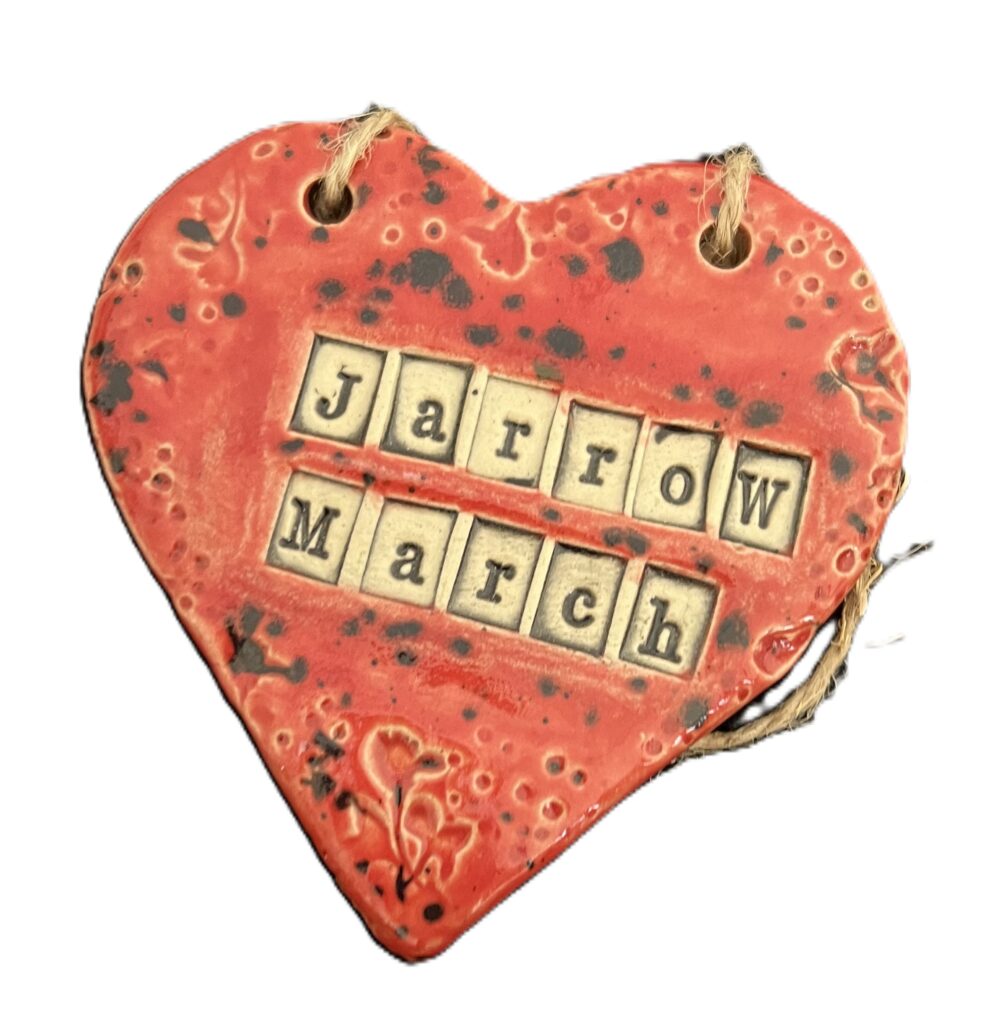
This piece highlights the Jarrow March of 1936. This was a very important event in the history of the town. On the 5th of October 1936, 200 unemployed Jarrovians began a long march to Parliament. They aimed to draw the Government’s attention to the extremely high unemployment and poverty in Jarrow during the Great Depression. There had been huge loss of jobs following the closure of Palmer’s Shipyard, the main source of employment. The marchers carried a petition signed by 12,000 people demanding a new steelworks.
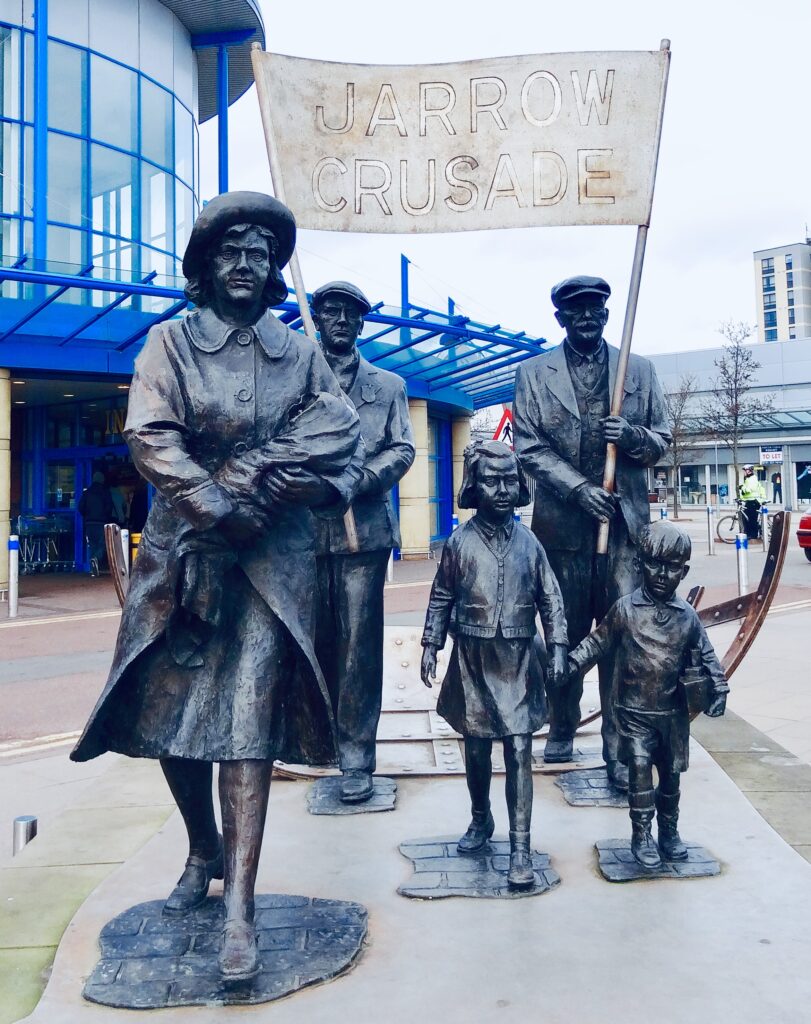
A mouth organ band boosted morale throughout the 25-day march until the protesters arrived in London on the 31st of October. Councillor David Riley was the marshall for the march. Ellen Wilkinson, MP for Jarrow, joined the march whenever possible and presented their petition to Parliament. She even led some songs along the way.
The petition was presented but not debated in Parliament and the marchers went home believing they had been unsuccessful. However, it was still a significant event which shed light on issues that became key to social justice reforms following the Second World War. For Jarrow, this is a key moment in the town’s industrial history. It is a moment which is commemorated in sculptures and artworks throughout the town.
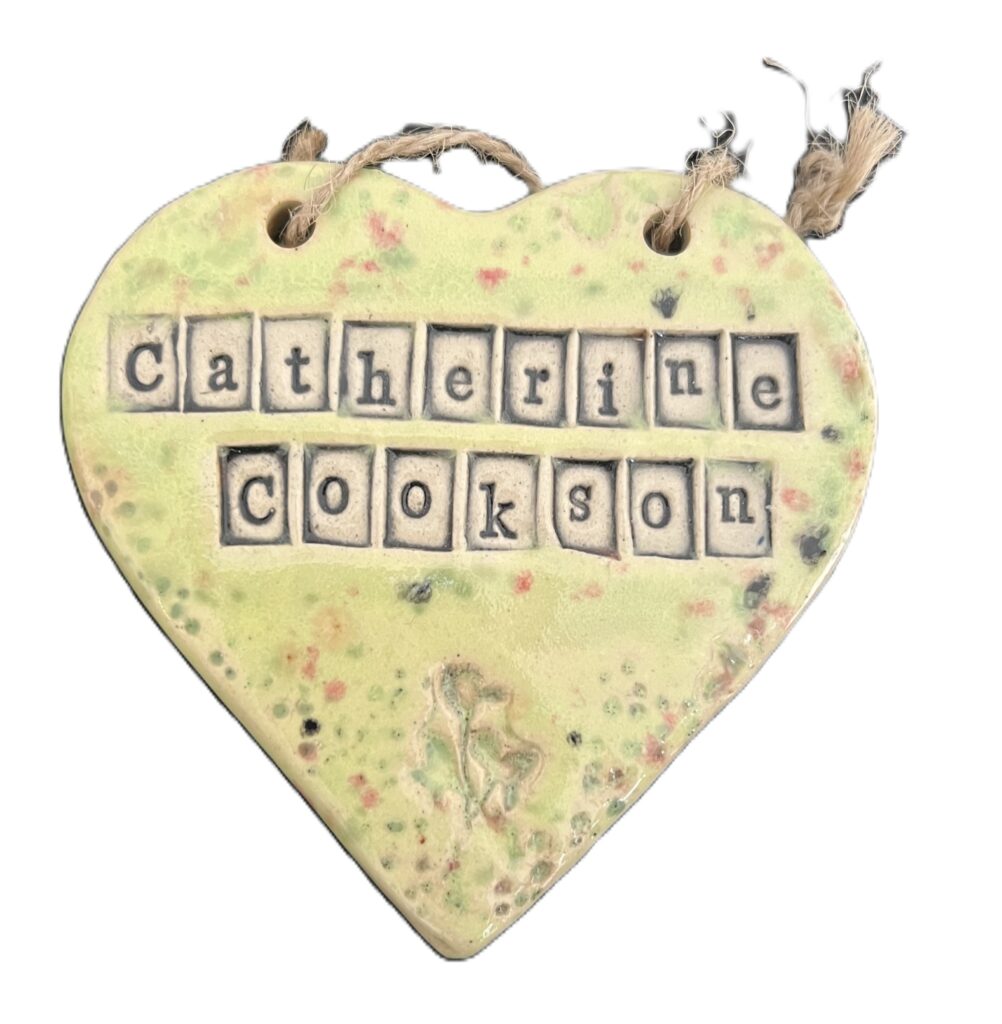
This final heart celebrates Dame Catherine Cookson. She was born in South Shields in 1906. In 1912 her family moved to East Jarrow. This is where she would set one of her best-known novels, The Fifteen Streets. She finished school at 14 and worked in domestic service before taking a laundry job at Harton Workhouse in South Shields.
Catherine took up writing as a form of therapy to help her cope with her depression. She was a founding member of the Hastings Writers’ Group and published her debut novel, Kate Hannigan, in 1950. Cookson wrote 104 titles which sold more than 123 million copies and were translated into at least 20 languages. For seventeen years she was the author with the largest number of books borrowed from libraries in the UK. She only lost the top spot to Dame Jacqueline Wilson in 2002. She was also one of the first patrons of Bede’s World which later became Jarrow Hall.
We hope you enjoyed this spotlight! Keep an eye out for future spotlight blog posts and displays coming soon.