
Hello, Welcome back to the JAMCam! We have some exciting updates this week. Firstly, we have fences!
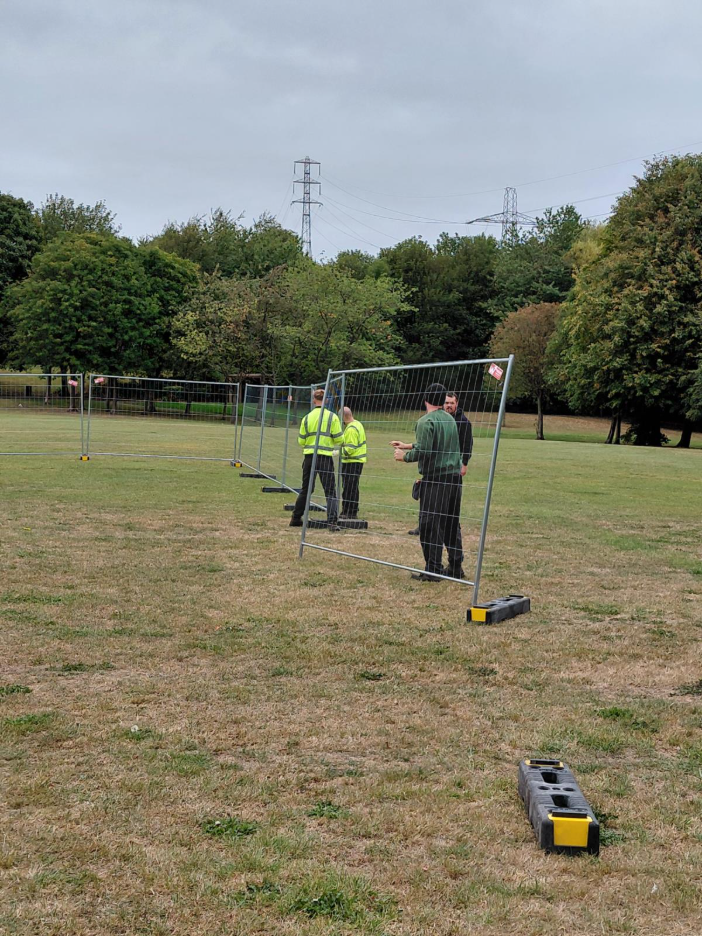
Images: The Jarrow Hall Land Team install fences to mark the site of excavation.
Our Heras Fencing finally arrived, which means that we were able to set up our area of excavation for the site. Altogether JAM will be working in a 400m² area of land in Drewetts’ Park, hopefully opening one 4mx20m main trench, and a few smaller test pits all within the fenced area. This should allow us to capture the extent of the potential feature present on site.

Image: We were joined on site by Northumbria University who helped us plot the boundaries of the site using their GPS.
‘What is that feature?’ I hear you ask. Well, we don’t exactly know, but we think we know. Previous Ground Penetrating Radar and Magnetometry surveys done by Sam Turner, Sarah Semple and Alex Turner indicate that there is a large, linear feature in the Southeast corner of Drewetts’ Park. To an archaeologist, this feature looks a bit like a paleochannel; an ancient riverbed, or even a man-made ditch. In either case, the mysterious features proximity to the Anglo-Saxon monastic site is too good an opportunity to miss. Ditches and old, dried-up rivers tend to turn into dumping grounds for everyone’s unwanted rubbish, but this is exactly why they’re archaeologically interesting; literally one man’s rubbish is another man’s treasure. In this case we hope that by looking for some Anglo-Saxon rubbish, we’ll be able to learn more about the everyday things that people might have used, thrown away, and even have taken for granted in the past. So, we do sort of know what the feature is, but at the end of the day you never really know until you dig it.
This week we were also joined on site by Jonathan and Charlie from the Tyneside Metal Detecting Association, who spent a day doing a metal detecting survey prior to excavation to give us a better idea of where to put our trenches by determining areas which are potentially high in metals. We were able to create quite a social history of the park, uncovering bits of household waste, clay pipe, a part of a tent pole and roughly £4.20 in loose change.

Image: Detectorists hard at work.

Image: A few finds already.
Perhaps the most staggering find was the sheer amount of rubbish. When we drop metal onto soft grass, over time it sinks into the soil due to its weight and things like rainfall and activity disturbing the soil. In an archaeological sense, finding rubbish is great; we can tell so much about a people by what they threw away. However, from an environmental perspective we should be trying to stop this habit. The UK Governments waste statistics for 2025 estimate that in 2020 the UK generated 191.2 million tonnes of waste material in 2020. This is an amount that would be unthinkable to our Anglo-Saxon ancestors, so we should all be trying to prevent our green spaces from being clogged up with pop cans and tinfoil.

Image: A small fraction of the rubbish recovered from the park.
So let that be a lesson to take your rubbish home with you; it all ends up underground in the end and the moles don’t deserve to live like this!