
“’Twas the night before Christmas, when all through the house
Not a creature was stirring, not even a mouse;
The stockings were hung by the chimney with care,
In hopes that St. Nicholas soon would be there;”
We’re almost halfway through the month of December and just nine days away from the winter solstice, so now seems like an excellent time to take a look at one of the most important people associated with the holiday season; SANTA!
Picture: The feet of a ceramic figure with a red, fur-trimmed coat and black boots… Santa?
All jokes aside, while researching Yule and its Anglo-Saxon origins, we at JAM HQ (i.e. that room above the Hive Kitchen) started to wonder; when did this ancient winter festival move from a ploy to seduce the sun back into the sky to a festival of merriment, with such a big focus on children especially.
We all think we know how Santa came into being; something, something Saint Nicholas… something, something Prince Albert … something, something Coca-Cola. But as it turns out, the origins of the behemoth figure we call Santa Clause are a little bit more complicated.
Saint Nicholas, a 4th Greek Bishop of Myra in modern day Türkiye, was renowned for his charity. Famously it is said that he once saved three young girls from being sold into slavery, by throwing bags of gold down their family’s chimney which landed in their stockings drying by the fireplace, thus providing them each with a dowry so that they could be married. St. Nicholas was popular throughout Europe, especially in the Netherlands where he became known as Sinterklaas. Saint Nicholas’s Feast Day was traditionally the 6th of December, and it became customary to give gifts to children in his honor. Sinterklaas became a sort of mythical figure, donned in red Bishops robes, who would give gifts to good children, while naughty children might be visited by any number of Sinterklaas’s alter-egos such as the terrifying Krampus.

Picture: 13th Century Icon of Saint Nicholas, Saint Catherine’s Monastery, Sinai (Egypt), K. Weitzmann: “Die Ikone”.
The idea of Sinterklaas managed to survive the Reformation in Europe, which attempted to move away from the idolisation of Saints, and made its way to America in the 17th Century.
It’s believed that it was in the Dutch colony of New Amsterdam (now New York) that Sinterklaas underwent his transformation into the jolly old man in a red coat we know today during the 19th century. This happened with a great deal of input from Clement Clarke Moore and his 1823 poem ‘A Visit from St. Nicholas’, better known as ‘The Night Before Christmas’. In his poem, Sata Clause arrives on Christmas Eve, instead of St. Nicolas’s Day, and is described as such;
“He was dressed all in fur, from his head to his foot,
And his clothes were all tarnished with ashes and soot;
A bundle of toys he had flung on his back,
And he looked like a peddler just opening his pack.”
Is ‘A Visit from St. Nicholas’ St. Nick is a scruffy, jolly, bearded old, man who oozes cheer and goodwill.
Now, here’s where it gets more complicated, because in England there was already an old man who personified Christmas and winter; Father Christmas, and he and Ol’ St. Nick were not the same guy.
Many English festive traditions can be dated to the late Medieval period, and some may even be older. In England, Christmas was a time of feasting, caroling or wassailing, and generalised debauchery if it can be believed; in other words, it was a decidedly adult festival.
Mentions of a personification of Christmas can be found in the 16th century as a creative metaphor for the Winter season. Though winter has been personified into people and spirits long before this, such as the Norse God Odin who was also often called by the name Jólnir or ‘Yule One’, connecting him with the winter festival, as we discovered last week. Characters such as the Tudor/Stuart ‘Lords of Misrule’ (or the Abbot of Unreason in Scotland) were people appointed to preside over wild Christmas parties, where drunkenness seemed to be the primary objective. It’s not until Christmas, along with other religious festivals, come under Puritan attack and eventual outlaw in the 17th century that the ‘Father’ is added to Father Christmas, as Royalists defended Christmas by depicting him as a sympathetic bearded man in old fashioned clothes. However, even after the Restoration, Father Christmas and the reveries he represented were still raucous and very grown up.
It’s not until the 19th century, where a greater focus is being put on the family and the plight of children, that Father Christmas begins to soften and become more family appropriate.
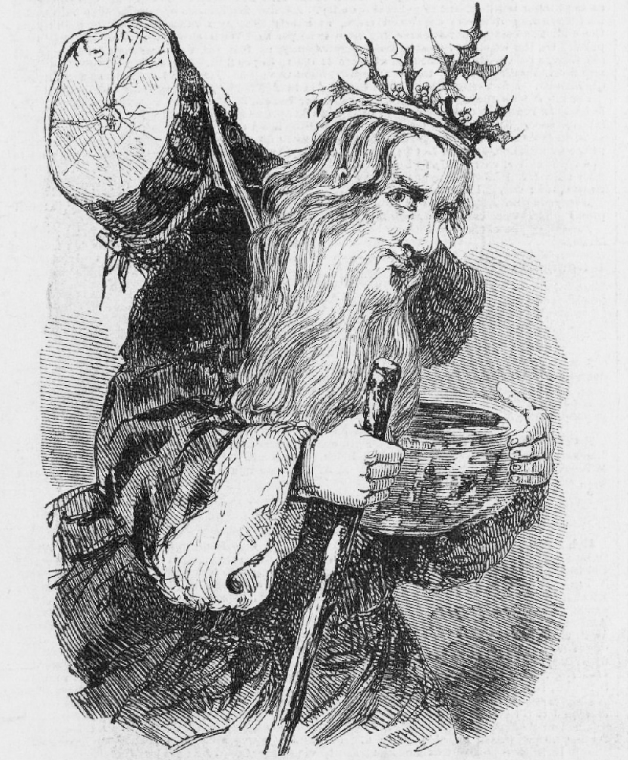
Picture: “Christmas with the Yule Log”, Alfred Henry Forrester, Illustrated London News, 1848
The 19th centurey saw an increased interest in curing social ills such as poverty and “anti-social behavior” in Britain. Particular urgency was felt on behalf of the nation’s children, or “the deserving poor”, who it was believed that the government had a duty to help rise above the poverty they were born into.

Picture: A handmade lead Whirligig would have been a simple and inexpensive toy, post-Medieval.
Parliament established organisations such as the Philanthropic Society, who worked to train young people in traditional trades, as well as the passing of Poor Law Amendment Act 1834 which created the Workhouse system, in which relief to the poor was only given in Workhouses which were purposefully made so miserable that only the truly destitute would go to them for help. Though the conditions found in workhouses would hopefully be considered barbaric by today’s standards, it did show a solidification of the idea that it was a secular duty, as well as a moral one, to care for our fellow man, and was also an important step in the centralisation of a British welfare state. Coupled with the work of artists such as Charles Dickens, whose depictions of workhouse orphans in Oliver Twist, Bleak House and David Copperfield, as well as social reformers such as Elizabeth Fry and Thomas John Barnardo, children were increasingly humanised, and took a more central role as a vulnerable and important demographic in Victorian Society.
To compliment this new interest in the lives and wellbeing of children, a new kind of Christmas was embraced. Much closer to the feast of St. Nicholas, and possibly more in line with a restrained Victorian social culture, Christmas became childish, with cards, toys and Games as the new standard.
Picture: A ceramic Knucklebone, a game piece, likely Victorian.
But there was still something missing! A character to embody this new attitude…
….you can probably guess the rest.
When ‘A Visit from St. Nicholas’ came to Britain, the depiction of Santa Clause became so popular that it quickly and irrevocably merged with the older Father Christmas, to create a new child friendly version of the character that we haven’t been able to shake off since.

Picture: Father Christmas Putting a ball in the stocking of sleeping children, drawn by K. Röger ca.1890 for Ernest Nister. Bequeathed to the V&A in 1970 by Anne and Fernand G. Renier as part of the Renier Collection.
This being said, many old traditions such as caroling enjoyed a renaissance, and Germanic traditions such as Christmas trees were popularised by Prince Albert and Queen Victoria. Throughout the UK many much older traditions have enjoyed a bit of a resurgence even more recently, as more and more people become interested in preserving folk tradition.

Picture: A Frozen Chalotte, a small doll popular in the Victorian era that would be baked into a Christmas Pudding as a game.
It would appear that we are rich in Christmas traditions, from home and abroad, and that Santa Clause himself was an international effort. Truly what the season is all about.