About the Museum

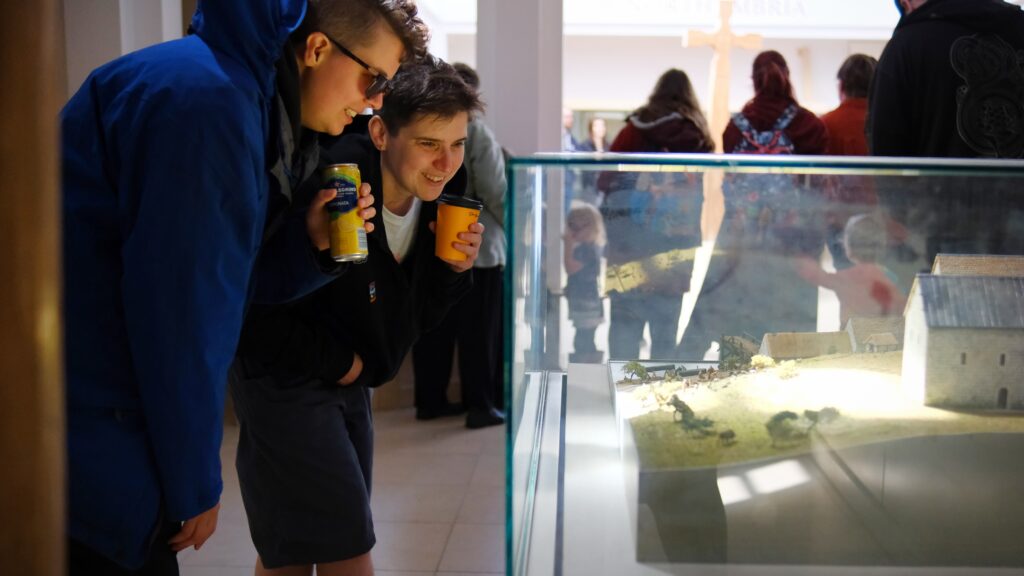
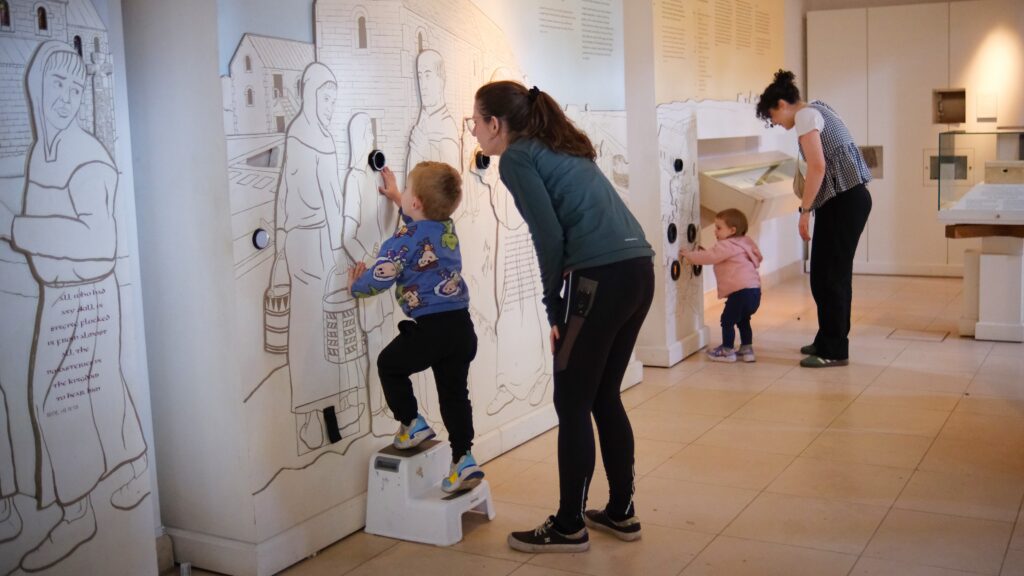
Our museum tells the story of Bede and his time, from the beginnings of the Anglo-Saxon period through his life, death and extraordinary legacy. Widely regarded as the ‘father of English history’, Bede was an author, scholar, linguist and translator who also composed works on astronomical timekeeping and the motions of the sun, Earth and Moon.

An English monk at the twin monastery of Wearmouth-Jarrow, his most famous work is The Ecclesiastical History of the English People. One of the most important original references on Anglo-Saxon history, this work also played a key role in the development of an English national identity.

Our Bede Museum is home to Europe’s largest collection of coloured glass from the 7th and 8th centuries, alongside unique stonework, artefacts and the Abbadia Reliquary, gifted to Jarrow Hall as part of our twinning with the Museum of the Abbey in Tuscany. The museum also hosts a full-sized reproduction of Codex Amiatinus; the oldest complete Latin Bible in existence. While one copy was passed on through time, the other two have been lost to history and our exhibition tells this incredible story. Codex Amiatinus and the coloured glass were featured as part of the Great Exhibition of the North’s A History of the North in 100 Objects.

Young Curators

This year we have been running our Young Curators project, encouraging local young people to create labels for some of our objects and share their interpretations of the past. Several young people have taken part in the project, Below you can see their responses:

L.1: Fragment of Stone Cross from Northallerton
"Huge, 5 m cross with circular and spiral designs. Very interesting for multiple reasons, one being the sheer strength and skill needed to carve such massive stone is astronomical, and to get the design so uniform across it is amazing. Another is the design itself. Circles and spirals appear in lots of cultures and in nature also, showing how many cultures take inspiration from nature. Intertwining this natural inspiration with Christianity shows a move away from the more nature-focused paganism to the more modern monotheism. Also its placement in the countryside served as a reminder that Christ is always watching over you, even in the most remote places" - Emily, 21
1995.223 - Copper-Alloy Stylus
"The object I’m looking at is a stylus made in the mid-Saxon era (7th century). It’s about 10.5cm long. People used it to mark and write on pages. It tells us that in the monastery, where it was found, people may have been writing scriptures or poems about their time way back then. It makes me think about what they could have been writing about before the monastery was no longer here" – Evie, 14
1995.223 - Copper-Alloy Stylus
"This stylus is used for making lines and margins in books. This possibly could have been used by a monk in the monastery. This is from around the 7th century." - Riley, 13
1995.223 - Copper-Alloy Stylus
"Shaped like an oar for a boat. Wide end is used as a handle. Scribes used it to write. Animal hide was used to make paper to write on and a knife was used to scrape away any errors" - Jack, 15
2025.0125 - Key Finger Ring
"Made of iron, about 1000 years ago. It tells us that in the past they may not have trusted other people so they had their keys on their finger" – William, 12
2025.0125 - Key Finger Ring
"This ring is a very handy item in fashion made out of metal. This ring could have been used for keeping valuables secure or as a flashy fashion statement. Maybe it was owned by a shopkeeper or a lord. This is from the late Anglo-Saxon or early Medieval period " – Riley, 13
2025.0125 - Key Finger Ring
"It looks like it may have been used to open doors or chests. It may have helped to keep things safe. Monks may have used this to keep scriptures safe or sacred relics. It was made in the Late Saxon to Early Medieval period." – Ruby, 14
2025.0125 - Key Finger Ring
"Used to lock small compartment such as a chest or box. Late Saxon or Early Medieval. Who used it? Why were they using it? What were they locking away?" – Alex
2025.0125 - Key Finger Ring
"This artefact is a key built into a ring. This used to be used for chests and other locks. Someone with valuables would have owned this, so they could lock them up. This could be to show off what they have. It was made in the Late Saxon/Early Medieval period." – Kai, 15
2025.0125 - Key Finger Ring
"The key ring appears to be a key on a ring. People may have used it to have as a symbol of power because they’re hiding something and I believe this was made during the Anglo-Saxon era" – Clarke, 15
1995.140 - carved sheep bone, possibly the mouthpiece of a musical instrument
"A sheep bone I think used as a whistle. Maybe a monk was playing a tune to help people concentrate. I think it looks like a finger" – Carter, 13
1995.140 - carved sheep bone, possibly the mouthpiece of a musical instrument
"This carved bone object is possibly a mouthpiece for a musical instrument or a whistle. This might have belonged to a musician. The bone object possibly could have been created in the Anglo-Saxon period or maybe the early medieval era." - Riley, 13
1995.140 - carved sheep bone, possibly the mouthpiece of a musical instrument
"This object might have been part of some kind of musical instrument. It was probably owned by a musician or bard. I like to think it would have been present at some fun Anglo-Saxon parties and feasts" – Bertie
1995.265 - rib bone with incised human face
"I really like this piece of graffiti. It makes me wonder who carved it and why they did it. Were they just bored and doodling? The lines are very straight so it looks like it was carved with a knife" - Anonymous
1995.265 - rib bone with incised human face
"This piece of bone has a humanoid face carved into it. This might have been used to inform about the arrival of aliens or just a piece of graffiti. This might have belonged to a superstitious person or a teenager causing mischief. The bone could have been carved in the medieval period." - Riley, 13
2025.022 - Copper-Alloy Harness Pendant
"It was used as a decoration on a horse’s harness. Rich people may have used or owned it as horses were expensive. Made about 600 years ago" - Emily, 18
2025.022 - Copper-Alloy Harness Pendant
"It was used as a decoration on a horse’s harness. Rich people may have used or owned it as horses were expensive. Made about 600 years ago" - Emily, 18
1997.4404 - Carved Stone Panel
"It was part of the original Saxon stonework for St Paul’s. Made by monks in around 680 CE." - Anonymous
2025.0124 - Copper-Alloy Ring
"This object is a copper-alloy ring with small, intricate triangles engraved around it. It dates back to the 15th century (1400-1500), making it around 500 years old. It makes me think of how people presented themselves in that time period and if the ring represents a certain status or meaning in society. We still are not sure who wore this ring but maybe someone who visited the monastery wore it" – Eryn, 15
2025.0125 - Stone with inscribed rune
"May have been used as a grave marker. Object was made over 1000 years ago in Anglo-Saxon times. The rune inscribed may be a bind rune which means it was two runes fused together. Whose grave was it? What did the rune mean?" - Alex
1995.892 - Cow femur with cutmark
"It’s hollow. Why are there butchery/cut marks?" - Max, 7
1995.892 - Cow femur with cutmark
£Used for food or cooking. I think it might be a thousand years old" – Corey, 8
1995.892 - Cow femur with cutmark
"The cow bone looks like a hoof of a horse. The marrow has rotted away so it’s hollow inside. The monks used their skin to write on. They also used their milk to drink and make food. It is the femur of a cow, which is the thigh bone" - Charlotte, 11
Shell
"It was used for a painting palette and it showed what they ate. Monks had fish in their diet. I think this was made a long time ago" – Kora, 8
Shell
"Monks used shells to mix and use paint. They could also grind the shell to make white paint" – Eva, 10
Shell
"It was used by monks for holding paints" - Wade, 11
Shell
"it was used for painting in the medieval period" - Anonymous
Green glazed pottery
"This is an early medieval green glazed pottery it is might be around 800 years old. I wonder how it got broken and it reminds me of frog’s skin. I also know that archaeologists stuck it back together. It is quite bumpy" – Alexander, 9
Green glazed pottery
"The medieval green glaze might have been used for storage of solids or liquids. The owner could have been a cook or a potter, maybe even a monk. This object was formed in around 1100-1400 AD" - Anonymous
Coloured glass
"Coloured glass for the guest house" - Charlie, 12
Coloured glass
"Shards of Saxon coloured glass perhaps from vessels" - Gaby, 15

Our Collection

There are currently over 12,000 accessioned objects within the museum collection, including: 

  • The largest European collection of 7th & 8th Century coloured window glass
  • A full sized Facsimili of the Codex Amiatinus, one of the earliest Latin bibles, produced here at Wearmouth-Jarrow by order of Ceolfrith, on long-term loan from the Friends of the World of Bede
  • Painted Anglo-Saxon plaster   
  • Magnificent Anglo-Saxon stonework
  • Archival material relating to the excavations of the Jarrow Monastery and Jarrow Slake

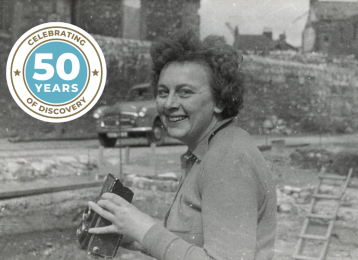
The museum was originally set up to care for and display internationally significant material from the excavation site of Jarrow Monastery, which was founded by Benedict Biscop in 681 AD as one half of the Wearmouth-Jarrow twin monastery. The site of St Paul’s Church was excavated extensively between 1963 and 1978 by Dame Professor Rosemary Cramp and her colleagues at Durham University.  

Jarrow Hall also cares for a small social history collection relating to both Jarrow Hall House, our Grade II listed Georgian House, as well as some local Jarrow history. The Georgian House was built around 1785 by local coal mine and shipbuilding industrialist Simon Temple.  


Find out more about our collections by exploring our interactive 3D models or searching our Online Catalogue.

Museum News

Online Catalogue

Explore our collection by searching our online catalogue to get some idea of the types of artefacts we hold, or click on the images to find out what more our museum holds.

Generic selectors
Exact matches only
Search in title
Search in content
Post Type Selectors
Search in posts
Search in pages
Archaeology
Exhibitions
Experimental Archaeology
Social History
Donations

We’re always interested in hearing from people who have stories and artefacts from the past that they would like to share with us. However, there are particular rules and regulations we must follow regarding donations made by members of the public.

Contact us via email or letter before bringing any items to the museum. 

You must first describe in writing what it is you would like to donate to the museum, how you came to own the object(s) and provide a photograph of the item(s) where possible.   

A member of the collections team will be in touch soon after to tell you whether this is an item we can accept, whether we need further information, if we cannot accept your offer, or to arrange a time and date to bring your item in.   

Please note our Collections Development policy will inform any decisions made by the museum.  

We do not accept any hazardous objects or substances.  

Experience more at Jarrow Hall

Unlock year round access to Jarrow Hall's rich history, captivating exhibitions and engaging activities with our 'Pay Once Visit for 12 Months' offer.