
The 20th of March is the anniversary of the death of St Cuthbert in 687 AD. It is also his feast day as a Saint. We know St Cuthbert as the patron saint of Northumbria. He is very important in the history of the region and the identity of its people. He was such an important figure that Bede even wrote about his life.
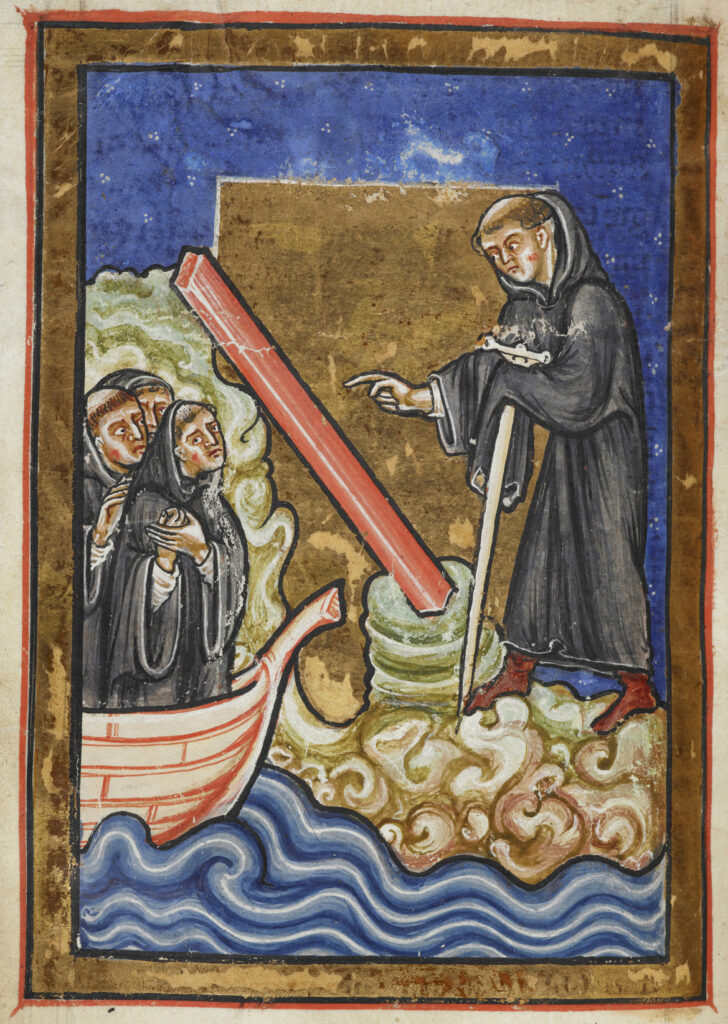
St Cuthbert was born around 634 BC in Dunbar. At the time, Dunbar was part of the Kingdom of Northumbria. His life before becoming a monk is a little murky. He decided to become a monk in 651 AD on the night that St Aidan, the founder of Lindisfarne, died. However, it seems that he did some military service beforehand.
He became famous for his piety and austere lifestyle, living a simple life as a hermit when possible. Cuthbert was also very generous to the poor. He was prior of the monastery on Lindisfarne from 665 AD. Cuthbert became Bishop of Lindisfarne in 684 AD. However, by 686 AD he retired to live as a hermit on the island of Inner Farne. He died on the 20th of March 687 AD.
During his lifetime he did influential work within the early Church. After the Synod of Whitby in 664 AD the Church in Northumbria began to follow the Roman customs rather than the Celtic ones. Cuthbert went to Lindisfarne to introduce the Roman ways to the monastery and ease the tension between the Roman and Celtic churches.
He also met with important people in Northumbria. Even while a hermit, he met Ælfflæd of Whitby. She was the daughter of King Oswiu of Northumbria and the successor of St Hilda as abbess of Whitby Abbey. She was famous for her skill in medicine and surgery and was an important woman in the early Northumbrian Church.
In 698 AD, people opened St Cuthbert’s tomb and said his body was incorrupt, meaning it had not decayed. They said this was a sign of how holy St Cuthbert was. People venerated him after his death. In 705 AD, Bede wrote a history of St Cuthbert’s life.
The Vikings first attacked Lindisfarne in 793 AD, more than a hundred years after Cuthbert had died. When the community had to leave the monastery in 875 AD to flee Viking raids, they carried Cuthbert’s coffin with them. The group travelled for 7 years until they settled for a time in Chester-le-Street. They ultimately settled in Durham in 995 AD, where St Cuthbert’s remains lie in Durham Cathedral to this day.
The story of Durham’s foundation says that St Cuthbert appears to a monk called Eadmer and said that the wandering monks should take his coffin to Dun Holm. After much more wandering, they came across a milkmaid at Mount Joy, near what is now Durham. She said she had lost her dun cow, which she had seen at Dun Holm. The monks decided that this must be a sign and followed her. They eventually came to the peninsula which is now in the centre of the city. They built a shelter for the relics there, in the spot where Durham Cathedral stands now.
St Cuthbert has a long legacy after his death. Alfred the Great was inspired in his fight against the Danes by a vision of St Cuthbert. Symeon called the people living between the river Tees and the river Tweed the ‘people of St Cuthbert’. The inhabitants of the Palatinate of Durham, between the rivers Tyne and Tees, were known as the haliwerfolc, which means ‘people of the saint’.
When his coffin was opened, a pectoral cross was supposedly found inside. This cross can now be seen on the arms of the University of Durham and Newcastle University.
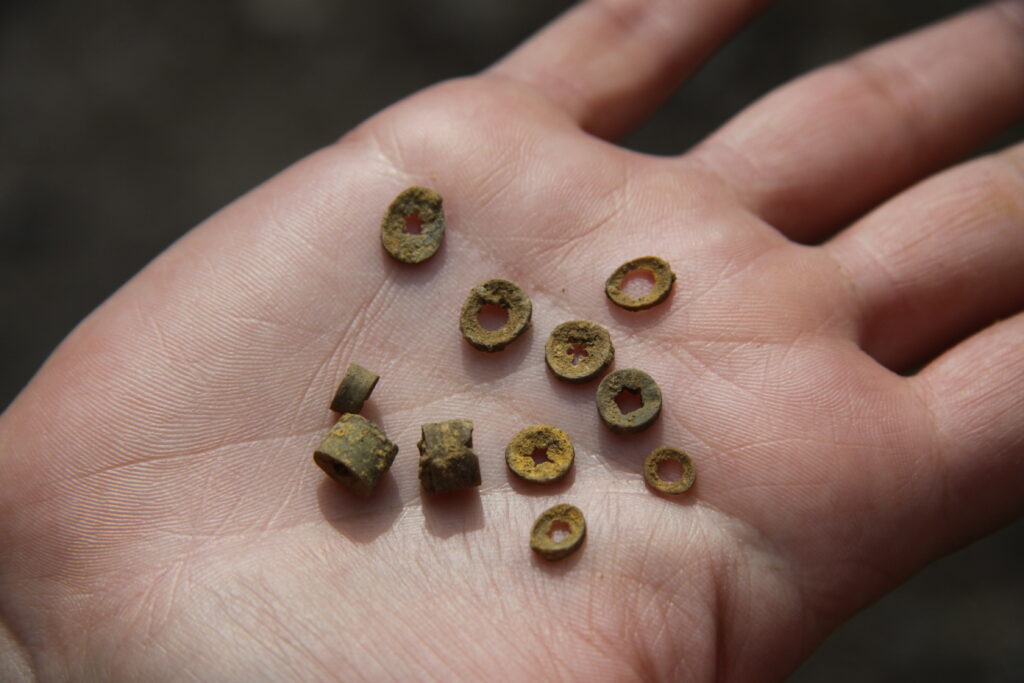

St Cuthbert is fondly nicknamed Cuddy. People in the North East may have fond memories of combing the beaches for the bead-like fossil crinoids called ‘Cuddy’s beads’. We often associate St Cuthbert with seabirds, and you may still hear the common eider duck called Cuddy’s duck.