
The 8th of March is International Women’s Day, a day of celebrating the achievements and impact of women in all areas of society. To commemorate this day coming up soon, we wanted to highlight some incredible Anglo-Saxon women. In their own way, each of these women held very important roles. They made a very real impact in Anglo-Saxon England and beyond.
St Hilda of Whitby, Saint and Abbess (c.614-680 AD)
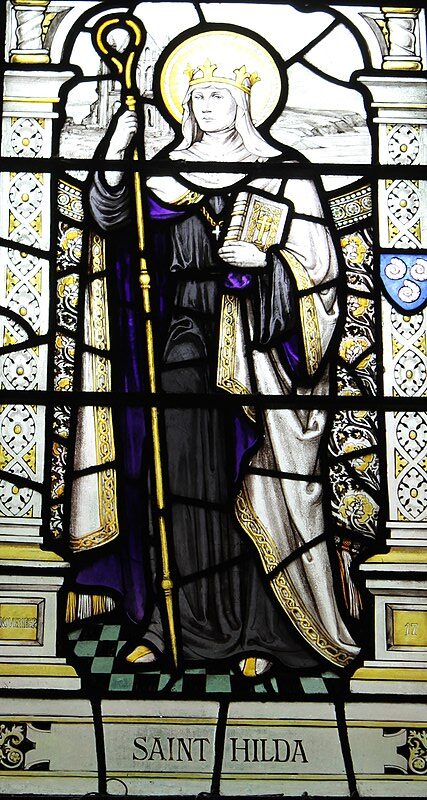
Hilda of Whitby was a very important figure in the early church in England, and later became a Saint. She is a patron saint of learning and culture. Hilda was also the founder and the first Abbess of Whitby Abbey. Bede writes about her in his Ecclesiastical History of the English People.
Hilda was born in 614 AD into the royal family of Deira. This was one of the two kingdoms which later became Northumbria. While she was still an infant, her father was poisoned while in exile in what is now West Yorkshire. Because of this, Hilda grew up in the court of King Edwin of Deira.
The widowed King Edwin married the Christian princess Æthelburh of Kent in 625 AD. In 627 he and his entire court were baptised. This included the 13-year-old Hilda. They were baptised in a small wooden church quickly built for the occasion near what is now York Minster.
At the age of 33, when Hilda was about to join her elder sister as a nun in what is now France, she decided instead to return to Northumbria and become a nun there.
In 657 AD she founded the double monastery that would become known as Whitby Abbey. A double monastery has separate but associated communities of monks and nuns. Archaeological evidence shows that her monastery was in the Celtic style. Its members lived in small houses, each for two or three people.
Bede writes that they followed the original rules and ideals of monasticism strictly in Whitby Abbey. Everyone had to study the Bible and do good works, and they shared everything in common. They saw the qualities of peace and charity as very important.
Bede also describes Hilda as a skilled administrator and teacher. She was a landowner with many in her employ to run the land. Hilda was also so well-known for her wisdom that kings and princes sought her advice.
“All who knew her called her mother because of her outstanding devotion and grace” – Bede on Hilda of Whitby
Whitby Abbey was so important that it was the venue for the Synod of Whitby in 664 AD. The Synod of Whitby was a very important event in which King Oswiu decided the Church in Northumbria would follow the customs of the Roman Church as opposed to the Irish one. This had a lasting and real impact of the future of the Church in Britain. Hilda herself attended the Synod.
Hilda suffered from a fever for the last seven years of her life but worked until her death at the age of 66. A local legend says that when sea birds fly over the abbey they dip their wings in honour of Saint Hilda.
Whitby Abbey continued until the Dissolution of the Monasteries in 1539.
Æthelflæd, Lady of the Mercians (c.870-918 AD)
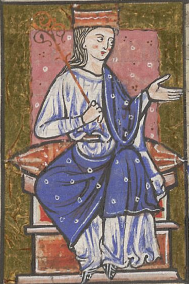
Anonymous, via Wikimedia Commons
Our second Anglo-Saxon woman, Æthelflæd, was born in Wessex in around 870 AD. This was at the height of the Viking invasions of England. She was the eldest child of Alfred the Great. Æthelflæd was a politically savvy woman, a negotiator, diplomat, and a warrior queen in her own right.
Her husband Æthelred was Lord of the Mercians. He and Æthelflæd’s brother, the future King Edward the Elder, played an important part in fighting off Viking attacks in the 890s. Æthelred and Æthelflæd fortified Worcester, gave generous donations to Mercian churches and built a new minster in Gloucester.
Æthelred’s health then seems to have declined. It is likely that after this it was Æthelflæd who was mainly responsible for the government of Mercia. She was probably responsible for restoring Chester’s Roman defenses. This is important as the Norse Vikings and the Danes later launched an attack on Chester. Their attack failed because Æthelflæd had fortified the town, and persuaded the Irish among the attackers to change sides.
After Æthelred died, Æthelflæd ruled as Lady of the Mercians in her own right. Some have called this the only case of a queen regnant of a kingdom in Anglo-Saxon history. Wessex did not call a king’s wife ‘queen’ or let them have much influence but in Mercia there was more of a history of openly influential women.
“a powerful accession to [Edward the Elder’s] party, the delight of his subjects, the dread of his enemies, a woman of enlarged soul” – 12th century Anglo-Norman chronicler William of Malmesbury on Æthelflæd
According to the Three Fragments, in 918 AD Æthelflæd led an army of Scottish and Northumbrian soldiers against Viking forces at the Battle of Corbridge in Northumbria. Historians consider this unlikely, but she may have sent a contingent to the battle.
Æthelflæd extended the network of burghs (fortified settlements) that her father Alfred had built. She also played an important part in conquering the Danelaw. The Danelaw was the area of England that lived under Danish law. In 917 she sent an army to capture Derby. Then, in 918, Leicester surrendered without a fight. Shortly afterwards the Viking leaders of York offered her their loyalty. Æthelflæd she died on 12 June 918 AD before she could take advantage of the offer.
Emma of Normandy, Queen of England, Denmark and Norway (c.984 AD-1052 AD)
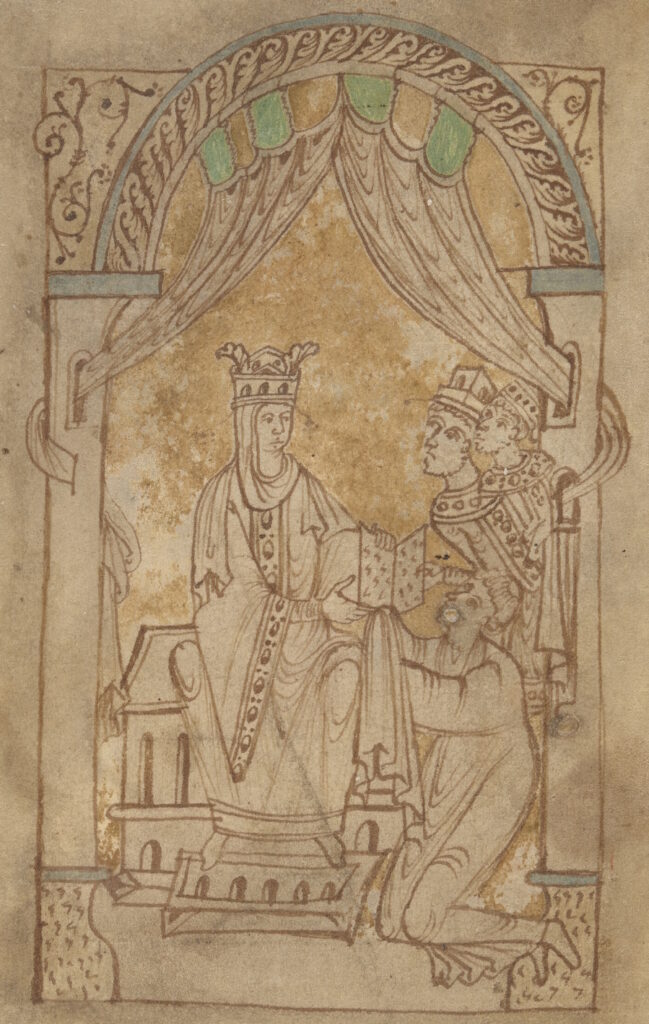
Emma was a Norman-born noblewoman who in her lifetime was the Queen of England, Denmark and Norway. She is also one of the most visually represented early Medieval queens.
Emma was the great-granddaughter of the Viking warrior Rollo and great-aunt of William the Conqueror. She married King Aethelred the Unready, and later King Cnut the Great.
King Aethelred was King of England reigning from 1002 AD to 1016 AD, except for a brief interruption where Sweyn Forkbeard was king in 1013 AD to 1014 AD. This marriage was a political one to strengthen ties between England and Norway.
After Aethelred’s death, she tried to have her eldest son Edward (the Confessor) crowned king but Aethelred’s son from his first marriage, Edmund Ironside, opposed this.
Sweyn Forkbeard’s son Cnut invaded England and took the throne. Emma married him, which strengthened Cnut’s position. Some say this may also have saved the lives of her children, as Cnut tried to rid himself of rivals but spared her children with Aethelred.
Emma was mother to Edward the Confessor by Aethelred and Harthacnut by Cnut. These men both became Kings of England, and she remained active in politics during their reigns.
“the most distinguished woman of her time for delightful beauty and wisdom.” – The Encomium Emmæ Reginae on Emma (translation edited by Alistair Campbell, published 1998, Cambridge University Press)
When Cnut died, Harthacnut succeeded to the throne of Denmark but was unable to travel to England. Emma remained in charge of the Royal Treasury and in a position of power. It was agreed that Harold Harefoot (Cnut’s son from a former marriage) would rule as regent while Emma held Wessex on Harthacnut’s behalf.
In 1036 AD, Alfred Aetheling and Edward the Confessor, Emma’s sons by Æthelred, returned to England from exile in Normandy to visit their mother. They were intended to be protected by Harthacnut, but he was preoccupied with ruling Denmark. Alfred was captured and blinded with a hot poker and later died from his wounds. This attack was under suspicious circumstances and some argue that it was on the orders of Harald Harefoot. Others suggest the blame Godwin, Earl of Wessex, was responsible as he was their protector while travelling.
Eventually, Harold Harefoot was recognised as sole king in 1037 AD. Emma fled to Flanders, where she stayed with relatives. However, she still had high hopes for her sons and after Harold died in 1040 AD, Harthacnut took the throne.
She may have played a part in Edward the Confessor becoming king, as when Harthacnut was close to death he invited Edward to England and named him the next king. Emma may have encouraged this, so she could secure her position by ensuring England would be ruled by one of her sons
Emma died in 1052 AD but during her lifetime had a substantial impact on England’s history.
We hope you enjoyed our celebration of International Women’s Day. The contribution of women has always been so important, and in fact we would not even have our museum here at Jarrow Hall without the excavations led by Rosemary Cramp. She was a pioneering archaeologist and the first female professor at Durham University.
Visitors to Jarrow Hall on the weekend of International Women’s Day will even be able to take part in a special trail as they go around the museum, so keep your eyes peeled for more to come