
Our newest spotlight is by Dake, a placement student who has been working with us for almost a year. Dake is a student from Durham University’s department of archaeology.
During this time he has helped us with lots of things but especially photogrammetry and creating 3D models of our objects. This has been incredibly helpful for our records.
This object (2019.0034) is one of the objects that Dake came across during his work. He wanted to explore it further.
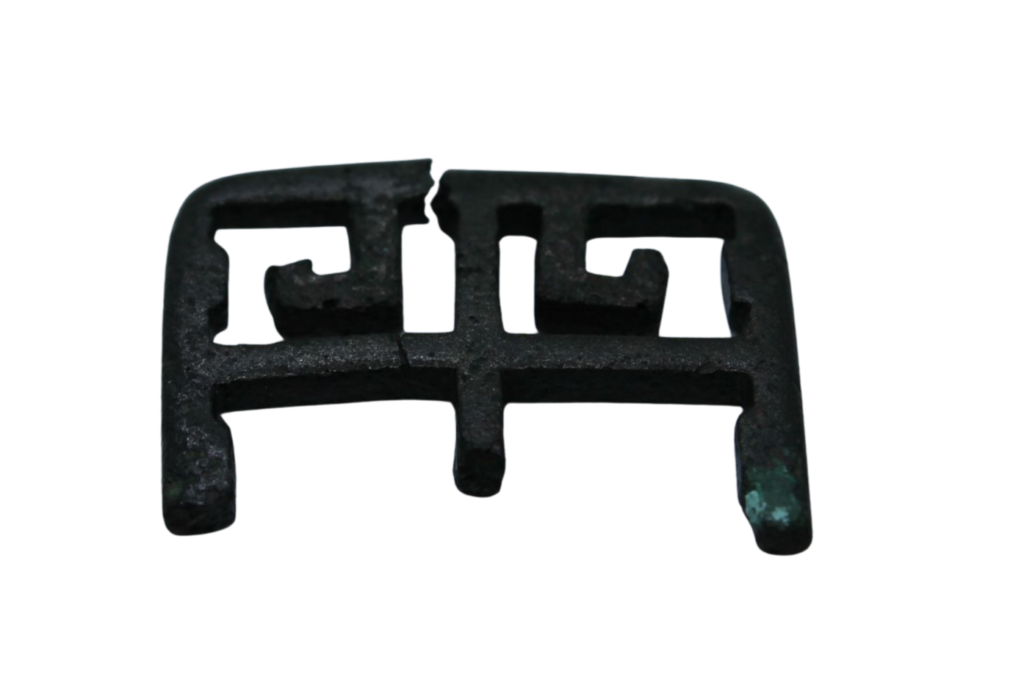
This artefact is small but heavier than it looks.
When archaeologists first uncovered this little bronze object here in Jarrow, they were not totally sure what they had found. What exactly is it? Even today, its records describes it as a strap-end, buckle, or clasp.
So what is the difference between these three things?
A buckle fastens a belt, strap or something similar. You might use a clasp to fasten a garment closed at the chest or shoulder, for example. A strap-end does not fasten anything. Instead, you fix them to the loose end of a belt to stop the leather from fraying and to give it a neat finish—rather like the plastic tip at the end of your shoelace.
So why don’t we know which it is? The answer lies in what is missing. Part of the object has broken away and without it, we cannot see the features that would tell us precisely which it was.
Even so, one thing is certain: somebody wore this object. And in the Anglo-Saxon world, what you wore was not just practical, it also carried meaning.
This small object was made of bronze, a mixture of copper and tin. To create something like this, a craftsperson would heat the metal until it melted, pour it into a mould, and then smooth and shape it once it cooled.
In Anglo-Saxon England, clothing was a powerful way to show identity. Individuals expressed who they were through details such as colour, fabric, and decoration. Even some dye colours were harder to produce and often linked to higher status. What you wore helped others understand your place or role in society at a glance.
Across Anglo-Saxon England, archaeologists have found belt fittings decorated with designs: woven patterns called interlace, geometric shapes, and twisting animal figures.
We see this clearly in Northumbria. Just north of here, at Bamburgh Castle—a royal stronghold of the Anglo-Saxon kings—lots of finely made objects have been found.
Imagine someone walking past wearing a shining buckle at their waist, a strap-end hanging from their belt, or a clasp fastening their clothing. The metal would catch the light.
These objects were practical, but they were also powerful signals. In a world without logos, small details in clothing helped people recognise one another and understand where they stood.
Now, the real question is this: if you lived in the Anglo-Saxon world, what would you wear to express yourself?
Below is a 3D scan of this object produced by Dake.