
Welcome to our newest spotlight! I recently had the pleasure of working with this wonderful little harness pendant in our collections, and it led me down a rabbithole of research.
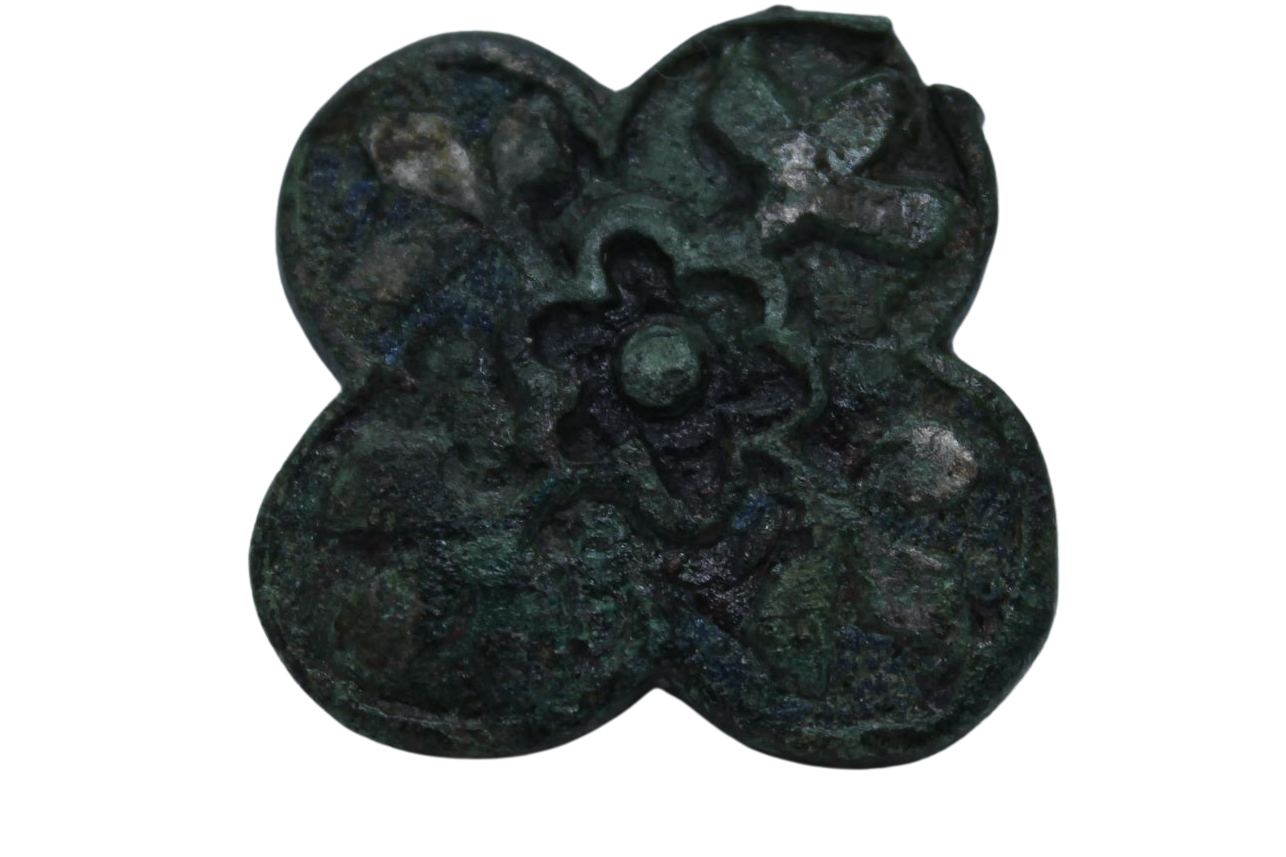
This example (2025.0022 in our collections) dates from the late 14th century, so around 1350-1400 AD. It is in a quatrefoil shape – this comes from the Latin ‘quattor’, meaning ‘four’ and ‘folium’ meaning ‘leaf’. You might see this shape a lot in churches as in the Christian tradition it can symbolise the four evangelists; Matthew, Mark, Luke and John. In the middle of this quatrefoil shape there is a sexafoil (or six-leaved) flower with four leaves radiating out from it.
Harness pendants would decorate the harnesses of horses, particularly the breast band. However, this wasn’t their only function! Sometimes these pendants had decorations with heraldic designs so the rider could show their allegiance to different families or places. They may also have had protective or amuletic qualities. In the Roman period, some people also used harness pendant as protection against the evil eye and some medieval examples have inscriptions, possbly to provide some magical protection.
Harness pendants might have been used by people from across different classes. Chaucer in the 1380s AD wrote the following about a monk in his Canterbury Tales:
“His bridle, when he rode, a man might hear
Jingling in a whistling wind as clear,
Aye, and as loud as does the chapel bell,
Where my lord Monk was Prior of the cell.”
It’s a lovely, vivid description which really gives a view into what these objects would have been like in use. You can really imagine the way they would have jingled as the horse rode by and the gilded surface flashed in the sunlight.
This particular harness pendant would have been enamelled, as you can still see in the images of the pendant. It would have been red in the centre with a blue background. It also shows evidence that it might have once been gilded. You can imagine how beautiful and colourful it would once have looked! It is easy to forget how bright the medieval period would have been. The past was not nearly as brown and grey as you might imagine.
Harness pendants like this one are not uncommon finds, with a majority dating between the 12th and 15th centuries, but they are fascinating decorative objects which help us paint a clearer picture of what the medieval period may have looked and even sounded like.
Archaeologists found our harness pendant during excavations of the site of the monastery here at Jarrow. I can’t help but wonder who might have owned it. What do you think?
I hope you have enjoyed this little journey into our collections. We have an incredible range of artefacts in our stores and one of my favourite parts of working with these objects is finding wonderful little gems like this.
Thank you for reading our newest spotlight! I leave you with a wonderful 3D model of this object made by our placement student, Dake.