
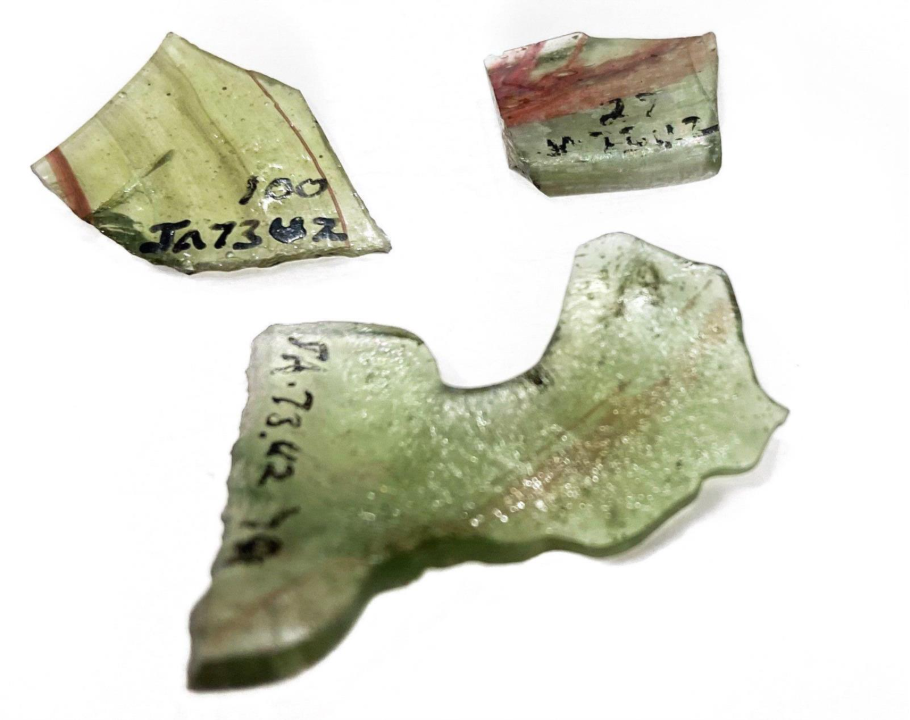
Image: Saxon Window Glass with Site Code JA73 and accession number in black ink.
Another week; another JAMCam, and this week we are taking a closer look at these examples of Saxon window glass held within our collection. This window glass was recovered during Rosemary Cramps’ excavations in Jarrow in 1973 which we can tell from the site code written on the objects; ‘JA(JARROW)73(1973)’.
It is no secret that when it comes to Anglo-Saxon glass, we at Jarrow Hall have a lot of it; 1,756 fragments from the Jarrow excavation alone. Many of these fragments were found so close to their point of origin that is was possible to reconstruct the window itself.

Image: ‘The Jarrow Christ’ reconstructed coloured glass window based on the Anglo-Saxon window surrounds in the chancel of St. Paul’s Church (Photo: Aidan McRae Thomson).
Anglo-Saxon glass from the period (around the 7th century) is relatively rare, in fact Jarrow Hall holds the most significant collection of Anglo-Saxon glass in Europe. This being said, there are other examples of glass found from this period in Britain and through analysis of these collections we can determine a few things about glass production. We know that the glass itself was produced in the Middle East, possibly Syria, and brought to Jarrow, where it was worked and coloured locally. We know this due to the soda-lime (marine plant ash) and sand composition of the glass, which is different from potash glass used in Anglo-Saxon glass vessels. This indicates a preference for a particular chemical composition for the raw materials used to make window glass specifically. The glass was cylinder blown, much like a vessel, and clipped in to shapes or Quarries to be fitted together like a mosaic. Coloured glass was created by adding metal oxides to the glass in its molten form during the blowing process. The collection at Jarrow certainly shows a superb level of care and artistary, in our example picture at the top of the page we can see red banding running through the otherwise clear glass, which certainly would have taken a high level of skill to achieve.
You might be thinking that this all seems like a lot of effort to go to for pretty glass; and it was. So why did the monks at Jarrow go to all of this effort. Well, we know that Benedict Biscop sent away to Continental Europe, Gaul more specifically, for craftspeople of all types to help guide the construction of the Monasteries’ at Wearmouth and Jarrow. This was to ensure that the buildings resemble the churches and monastic sites he had seen on his travels in the Continent. Biscop was famously a traveled man; his entire ethos when creating a monastic community at Jarrow and Wearmouth was more closely linked to Continental ideas of monasticism than that of insular British Christianity. We know this because it was recorded by his most famous pupil; The Venerable Bede.
Finally, why is this archaeologically important?
By examining the glass in our collection we’re able to get a better idea of trade and movement in the Anglo-Saxon world. We can see that, despite the fact that knowledge of glass production might have been lacking in Britain during the 7th century, knowledge of trade routes was not. The monks at Jarrow knew exactly where to get the raw materials they wanted, or at least who to ask about getting them, indicating that trade and communication throughout what was once the Roman empire was still active. This also shows that people travelled, perhaps not from Jarrow all the way to Syria to collect the glass themselves, but far enough to maintain trade contacts and exchange information, skills and ideas. We know that craftspeople from Gaul came to instruct the monks or even local artisans on the creation of the glass, and they would have brought particular ideas and aspects of their culture with them. Perhaps they were the ones who Gatekept the knowledge of glass production and materials as the secrets of a highly skilled and sought after profession, or perhaps they modified the techniques and materials they used to fit with what Biscop wanted. They may have trained up local artisans and monks to be able to work on glass independently, or perhaps some of them settled down in the area to continue their trade.
This is all to say that through in depth study of the archaeological material and historic sources we can infer something about the secular and religious connections forged and maintained by people at Jarrow. The kinds of glass we have in our collection wouldn’t exist if not for connection, travel and communication across the Old World. We can see that some of the knowledge of glass making had been lost to Anglo-Saxon Britain after the dissolution of the Roman Empire, but not the social and commercial connections that allowed that knowledge to be revived. This information is part of why we can call Jarrow Monastery one of the most important ecclesiastical sites in Europe, and is an aspect of the sites history we hope to explore further with JAM.