

Image: Bone spindle recovered from Trench 304, Context 2036.
Today on the JAMCam we’re looking at another object from our collection; this beautiful Mid-Late Saxon bone spindlewhorl. This artefact was found during Rosemary Cramp’s excavations of the monastic site at Jarrow St. Pauls in 1973. It was found in context 2036.
This spindlewhorl, or just spindle, seems to be typical of the time period, and is made from the proximal epiphysis of a cattle femur. Roughly translated, this means that the rounded nub on the head of the femur, one of the leg bones, of a cow was taken and drilled with a small hole to make the spindle.
Spindles were used in the creation of thread and yarns for making fabric, commonly linen or wool. When making these particular fabrics, first the raw material is gathered; the sheep are sheared, and the wool is washed, combed and processed in preparation for being turned into fabric. Then the raw material is spun into string or yarn using the wight and speed of the spindle to determine the coarseness of the thread. The spindle is used as the weight which tightens the strands of fibre and spins it into a length of string.
Spindles are found throughout most periods of history and were still used until quite recently.

Image: Print dating from the 17th Century, housed in the Rijksmuseum, Netherlands.
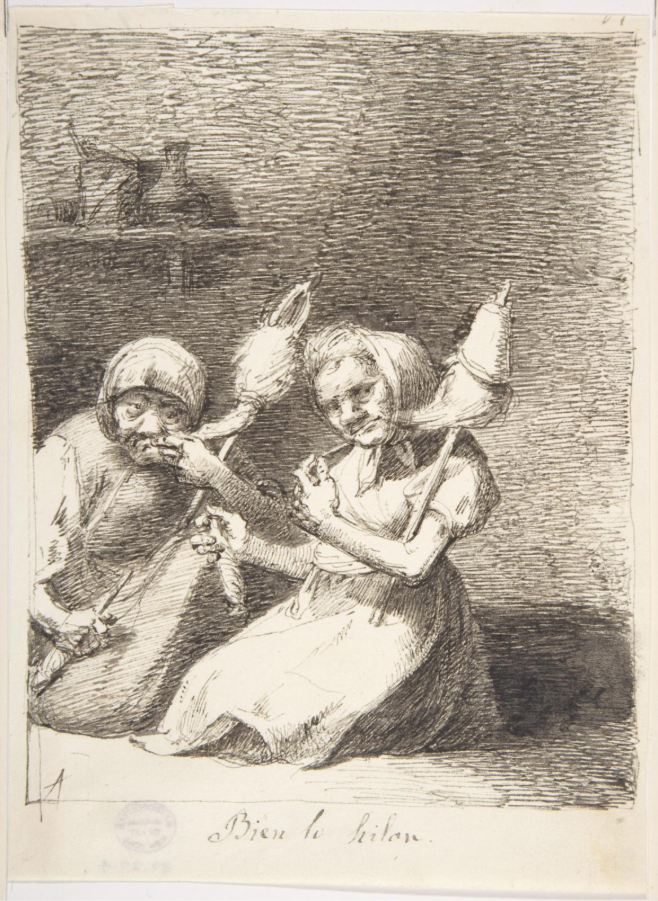
Image: “They Spin Well” by Leonardo Alenza y Nieto, early 19th century. Here women are ‘wet spinning’ flax by running the fibres through their mouths.
Often, craft activities have been associated as “women’s work” by historians. One reason for this is that spindles are often found in graves associated with female skeletons as they were an important tool in life, so would probably be an important too in the afterlife as well. Another reason that historians have often thought of crafts as “women’s work” is that crafts tend to be a sedentary activity associated with the home. It has been assumed that women would take on the responsibility of this work so that they could stay at home with the children nearby. However, there are 101 reasons why someone might be doing more sedentary labour instead of being out and about; they could be injured and doing work while they recover, maybe they’ve retired out of fighting and farming and are now focusing on labour in the house, maybe they are a professional weaver who is skilled at what they do, maybe they just really, really need more yarn and they might as well just make it themselves. On top of all of this, as I’m sure anyone with children will tell you, if there’s one thing children love, it is being everywhere except where their mums want them to be. So, what can we do to keep children in one place, well making string might be a start!
This isn’t to say that women didn’t make string and textiles in the Anglo-Saxon period, but that there might be lots of reasons that they’re making textiles other than “that’s their job because they’re girls”. Thinking like this can devalue this kind of essential labour, or “domestic labour”, as more like a hobby than an important and skilled form of work. It also erases all of the other people who would engage in the domestic labour needed to run a home, a monastery or even a village, and creates a perspective where women were just homemakers and men were always farmers or warriors. When we as enlightened citizens of 2025 see historical interpretations that suggest as much, it’s best to ask if that was really the case, or did the men that first suggested these ways of thinking about people in the past think like this because that’s what their world looked like, and it made the most sense to them.
Now with all of that considered, this was a monastic site, mostly occupied by male Monks, which would support evidence that the monks were responsible for making their own resources. Now of course some things were likely given, and some things bought, but strings and yarns would have been needed every day for making and mending, so it’s likely that the monks at Jarrow made their own. This isn’t very surprising, we know the monks were responsible for building the monastery, growing their own food and medicine, and catching fish, so doing their own craftwork alongside their monastic duties makes a lot of sense. We have numerous examples of needles, combs and other crafting tools on display in the museum and in our collections.
As this spindle is made of bone, we can tell a little bit about the kind of animals that were kept in the area and the wide range of uses livestock were put to in the Anglo-Saxon period. We know that cattle were reared in the area and were probably used for milk, meat and leather hides, but this spindle also tells us that bones, which are often considered waste, were also an important and accessible resource. This part of the bone is one that, when the animal is young, is separate from the rest of the femur and fuses with the larger bone as the animal ages. Depending the marks left by the craftsperson when they were making the spindle, we might be able to tell when animals were slaughtered and get even more specific information about what the livestock economy of the area was focused on.
All this lets us paint a picture of the past; its people and what they were doing every day, how they raised their animals and what things were important to the monastic economy as well as way of life. By looking at all of these things together we get a more complete idea of life in the Anglo-Saxon period. JAM hopes to add even more detail by taking a closer look at the everyday lives of medieval people, and by asking new questions about their experiences.