
Image: The JAMFam installing project posters on site.
Today we wrapped up a week of hard work behind the scenes at JAM. Museum staff, along with our Lead Volunteers have been working with staff from Archaeological Resource Services to make sure that we’re up to scratch on our knowledge of the archaeological process as well as the finer details of running an excavation successfully.
We also had the privilege of working with members of the Veterans’ Archaeology Association North East to begin de-turfing the site ahead of excavation. We are de-turfing our trenches by hand to ensure that no unnecessary damage is done to the park, and so that we can re-establish the grass turfs when we are done at the end of September. Due to the dry conditions and compacted nature of the soil in the park, de-turfing is a sweaty job, and we expect to still be de-turfing into next week, but we could never have made the amazing progress that we have without the valuable help of the veterans.
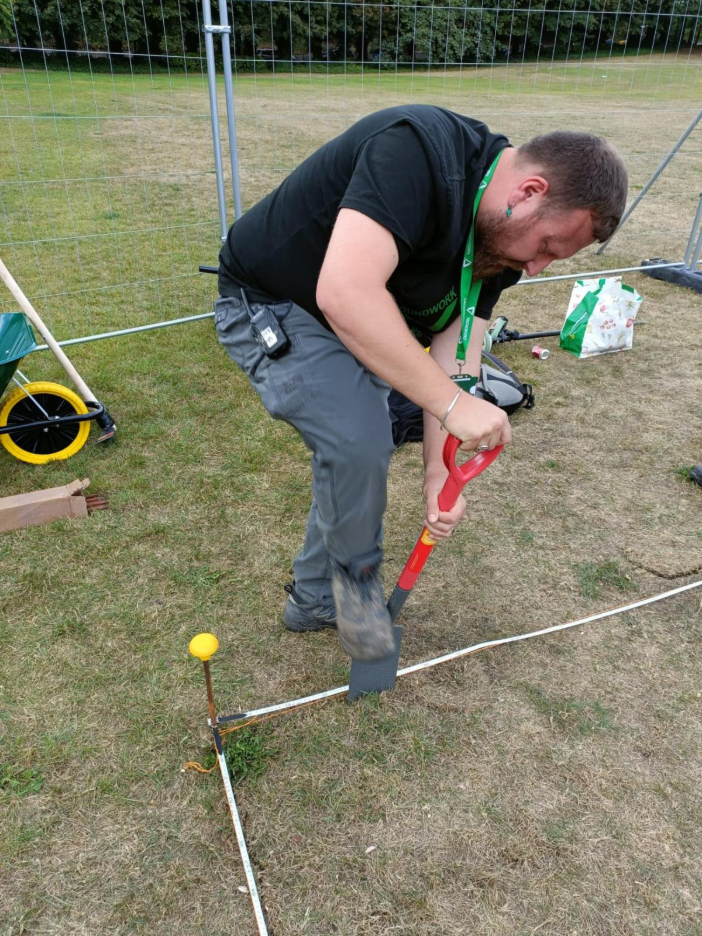
Image: We’re gonna’ need a bigger spade.
We may not be excavating quite yet, but that doesn’t mean there hasn’t been anything to learn. We’ve discovered that there is a layer of dark, ashy soil just below the grass in Drewett’s’ Park. We believe that this was deposited in the late Victorian/Edwardian Period and is made up of mostly domestic household fire waste. We have been able to determine this based on some of the things found during our Detectorist survey last week and de-turfing this week. Finds have mainly been shards of porcelain teacups and a few pop-bottles, but even these have been enough for us to give a broad date to the ashy deposit. It is possible that there was a dip in the park where we are excavating and that when the area was being landscaped, household waste was gathered and used to level the ground. Alternatively, this deposit may have formed the base layer of a pathway which once existed between Jarrow Hall and St. Paul’s Church. These theories have also been corroborated by members of the public, who have described a similar phenomenon in other parks nearby.
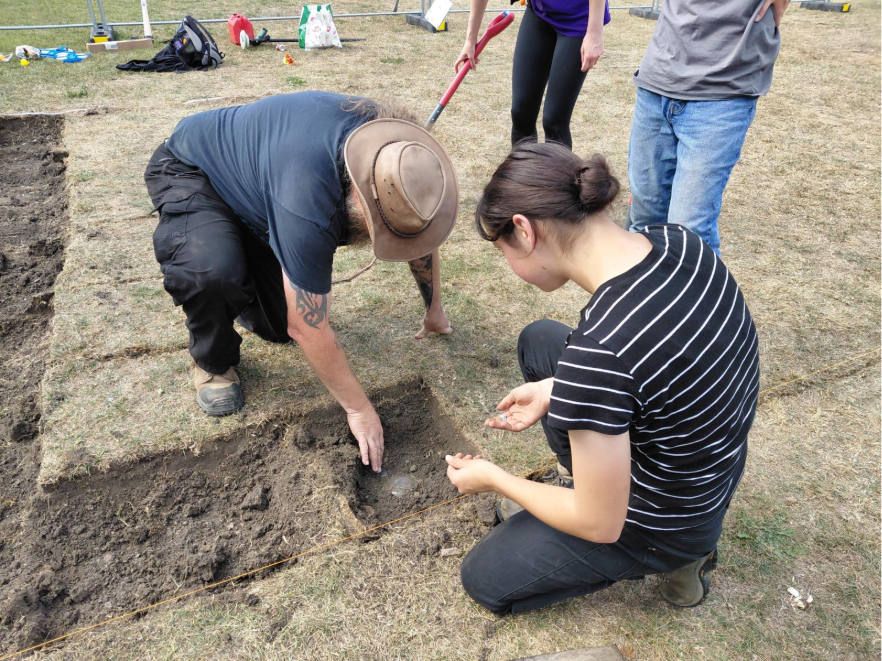
Image: Unearthing a fragment of a modern glass bottle.
We have also used this week to refresh our archaeological recording skills. Archaeologists record sites in a number of different ways; most commonly through hand drawing and photography, though we will also be using a GPS. We do this because archaeology is inherently destructive. Yes, we might have some beautiful finds at the end of a dig, but the context from which they were recovered holds the greater amount of information about the object as well as the wider period which we want to study.
Context allows us to paint a picture of a time in history or of a singular event. For example, a hoard of Anglo-Saxon coins might be found in a field, but where in the field? Is the field on top of a hill? Was the hoard found under a tree or by a river? Was the hoard found within a pit? Was the pit dug for the purpose of depositing the hoard? Do we know if the pit was used for something else before it held a hoard? What kind of soil was in the pit? Was it rich in organic material? Are there inclusions in the soil like charcoal? Can we use these inclusions for Radiocarbon Dating?
This is all archaeological context. If we were to just dig through everything willy-nilly with no attempts to answer these questions or record the excavation process as we go, we would know almost nothing of significance about the hoard, and since we have to dig through the field, and the pit, and the soil inside the pit to get to the hoard, we are destroying the archaeological context of the hoard. THIS is why archaeological recording is so very important; if we make sure we are recording everything as we go to the absolute best of our abilities, then we can justify the destruction of archaeological context because we are able to pass that information on to anyone who might want to study an artefact or a site in the future.
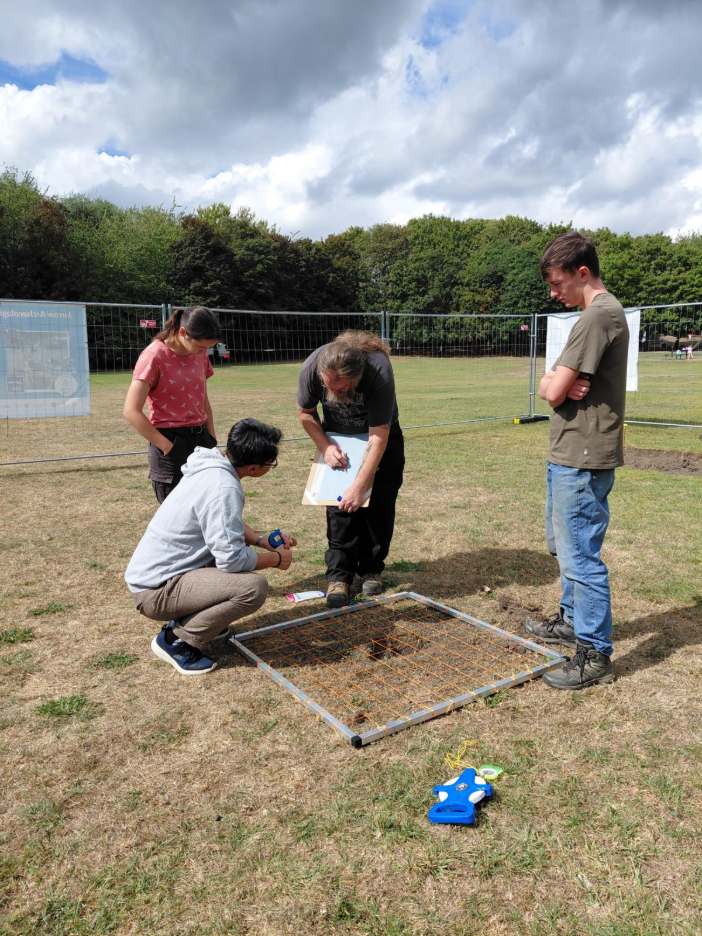
Image: Practicing drawing with a Planning Frame.
Lastly, we would like to thank the community for being so friendly and helpful this week. We have all appreciated the support and kind words when we’ve been spotted preparing the site and it is wonderful to see a community who are so proud of their heritage. We have noticed that there have been some especially keen beans who have perhaps jumped the site fence of an evening and had a poke around to see what we’ve been up to. We urge you not to do this, as it can damage archaeology and, more importantly, put yourself at risk of injury. If you are interested in seeing what we’re doing on site, then just sign up to volunteer with us here!